Showing posts with label Catholic England. Show all posts

Thursday, October 9, 2008

Catholic England V - St. Edmund, Martyr


Martyrdom of St. Edmund, Pickering, N.Yorkshire
"This very fine (and, like all those at Pickering, very large) painting was made, like all those in the church, sometime between 1461 and 1483, and in its less exalted way it is, I think, as much on the cusp between ‘Medieval’ and ‘Renaissance’ as, say, Gentile da Fabriano’s Adoration of the Magi altarpiece of 1423. Edmund, crowned and already with a halo, is bound to a tree with a bubble-like cloud of flourishing leaves showing above his head. He is pierced with many murderous-looking arrows fired by the four archers who surround him. Their garments, including the deeply fashionable very short tunic, are more appropriate for swaggering young men of the town than military archers, whether English, Danish or for that matter Roman, since the influence here from paintings of the Martyrdom of St. Sebastian is surely undeniable. The two archers in the foreground in particular look thoroughly Italianate in their elegantly articulated and posed bodies - the one on the left apparently restringing his bow, the one on the right looking thoughtfully at Edmund."

"Entirely medieval in spirit though are the inscriptions at the top of the scene. Around Edmund’s head, angelic hands (the one at the left clearer) hold a continuous scroll. Only the word ‘Edmund’ to the left of the tree’s foliage is readable, but the rest of the sentence probably identified him fully as martyred King of the East Angles. The second scroll on the right, curving around the head, shoulders and elbow of the upper right-hand archer, reads ‘Heven blyß to his mede, hym s[h]all have for hys gud de[de]...’. "

Tuesday, October 7, 2008

Catholic England IV - St. Edmund, Martyr


Now this portion of the life of St. Edmund is considered a legend and is in fact not even mentioned in the Catholic Encyclopedia. This is a nice story, which may or may not be true. All things are possible for the Lord who commands everything in His creation! These are the things among which will not be revealed until the end of times when all things will be made known. It is a nice story and I can imagine in medieval times it being elaborated upon with each generation's telling, but how many were indeed edified by it?

Abbo of Fleury's life of St. Edmund continues the narration of Edmund's martyrdom by decapitation as follows:

"His severed head was thrown into the wood. Day and night as Edmund's followers went seeking, calling out "Where are you, friend?" the head would answer, "Here, here, here," until at last, "a great wonder", they found Edmund's head in the possession of a grey wolf, clasped between its paws. "They were astonished at the wolf's guardianship". The wolf, sent by God to protect the head from the animals of the forest, was starving but did not eat the head for all the days it was lost. After recovering the head the villagers marched back to the kingdom, praising God and the wolf that served him. The wolf walked beside them as if tame all the way to the town, after which it turned around and vanished into the forest."


After giving the head and body a speedy burial, the kingdom rebuilt itself for several years before finally erecting a church worthy of Edmund's burial. Legend told that upon exhumation of the body, a miracle was discovered. All the arrow wounds upon Edmund's corpse were healed and his head reattached to his body. The only evidence of his previous decapitation was a thin, red line around his neck. Despite being buried for many years in a flimsy coffin, his skin was soft and fresh as if he were merely sleeping the entire time.

In Percy Dearmer's The Little Lives of the Saints, we are told of Edmund's posthumous revenge on the Danes:

“...the last heathen Danish king, Sweyen (the father of Canute), tried to destroy (Bury St Edmunds). He laid siege to it, and demanded all the treasure of the church, else he threatened to destroy the church and kill all the clergy; and this he said with many taunting words about the saint who lay buried there. But as he was sitting on his war–horse, waiting to attack the town, he saw in the sky St Edmund coming towards him, a crown on his head and a long bright lance in his hand. 'Help, friends!' he cried. 'Edmund is coming to kill me!' Then he fell down, and died in convulsions.


Sweyn's son, King Canute, converted to Christianity and rebuilt the abbey at Bury St Edmunds. In 1020, he made a pilgrimage there and offered his own crown upon the shrine as atonement for the sins of his forefathers.

Monday, October 6, 2008

Catholic England III - St. Edmund, Martyr


This is by far my favorite image of St. Edmund martyr from the famous "Wilton Diptych" This post will focus on this beautiful and moving piece of art. If you are a total nerd like me who loves the Catholic church and her saints, medieval English history and art - this post is for you! :)

From Wikipedia: "The Wilton Diptych (c.1395-1399) is a small portable altarpiece of two panels. It is an extremely rare survival within England of late Medieval religious painting.
The diptych was painted for King
Richard II of England who is depicted kneeling before the Virgin and Child in what is known as a "votive portrait".
The painting is considered an outstanding example of the
International Gothic style and possibly of English art. It belongs to the National Collection and is currently housed in the National Gallery, London."


Here is entire left side of the diptych:

"... the kneeling King Richard II is presented by the Saints John the Baptist, Edward the Confessor and Edmund the Martyr. In the right hand panel the Virgin Mary with the Christ Child in her arms is surrounded by eleven angels, against a golden background and field of delicately coloured flowers."


Interpretation: The identity of the kneeling king is known because the angels surrounding the Virgin are wearing the livery of Richard II, the White Hart, which also appears in the brocade of the left panel and the outside of the diptych. As Richard kneels, the Christ Child reaches towards him in benediction and also reaches towards the pennant held by an angel, and significantly placed between them. This pennant is the symbol of Richard's kingship and of the Kingdom of England as a whole, It bears the Cross of St. George, the symbol of England and furthermore surmounting the staff is an orb on which is tiny map of England.

All three saints who present the kneeling Richard to the Virgin and Child are believed to have been venerated by the king, as each has his own chapel in Westminster Abbey. Each saint holds the symbollic attribute by which they are recognised in art. Edmund the Martyr, who stands to the left, holds the arrow which killed him in 869, while Edward the Confessor, at the centre, holds the ring he gave to a pilgrim who transpired to be the disguised John the Evangelist. John the Baptist (right) holds his symbol, the Lamb of God.


The image on the left makes reference to King Richard's birth on 6th January. This is the feast day that Christians celebrate Epiphany, when Christ was adored by three kings and also the baptism of the adult Christ with John the Baptist shown touching Richard's shoulder.
John the Baptist was Richard's Patron Saint, and Saint Edward and Saint Edmund had both been English kings. Richard had a special devotion to Edmund, who with St. George is one of the patron saints of England.
The painting is indicative of both Richard's belief in his divine right to rule and his genuine Christian devotion. It also importantly symbolises (in the form of the Pennant), Richard II giving his kingdom into the hands of the Holy Virgin, thereby continuing a long tradition by which England was known as "Our Lady's Dowry" and was thought to be specially under her protection
(source)

Friday, October 3, 2008

Catholic England II - St. Edmund, Martyr


The Story of the martyrdom of King. St. Edmund:

In the year 869, the Danes who had wintered at York, marched through Mercia into East Anglia and took up their quarters at Thetford. Edmund engaged them fiercely in battle, but the Danes under their leaders Ubbe Ragnarsson and Ivar the Boneless had the victory.

According to Abbo of Fleury, Edmund's earliest biographer, the story came to Abbo by way of St Dunstan, who heard it from the lips of Edmund's own sword-bearer. In Abbo of Fleury's version of events Edmund refused to meet the Danes in battle himself, preferring to die a martyr's death, with conscious parallels to the Passion of Christ:

"King Edmund stood within his hall of the mindful Healer with Hinguar (Ivar), who then came, and discarded his weapons. He willed to imitate Christ's example, which forbade Peter to fight against the fierce Jews with weapons. Lo! to the dishonorable man Edmund then submitted and was scoffed at and beaten by cudgels. Thus the heathens led the faithful king to a tree firmly rooted in Earth, tightened him thereto with sturdy bonds, and again scourged him for a long time with straps. He always called between the blows with belief in truth to Christ the Saviour."

"The heathens then became brutally angry because of his beliefs, because he called Christ to himself to help. They shot then with missiles, as if to amuse themselves, until he was all covered with their missiles as with bristles of a hedgehog, just as Sebastian was. Then Hinguar, the dishonorable viking, saw that the noble king did not desire to renounce Christ, and with resolute faith always called to him; Hinguar then commanded to behead the king and the heathens thus did. While this was happening, Edmund called to Christ still. Then the heathens dragged the holy man to slaughter, and with a stroke struck the head from him. His soul set forth, blessed, to Christ."

The king's body was ultimately interred at Beadoriceworth, the modern Bury St Edmunds. The shrine of Edmund soon became one of the most famous and wealthy pilgrimage locations in England and the reputation of the saint became universal.

(photo credit)

Shrine of St. Edmund prior to its desecration and destruction during the wicked and misguided Catholic persecution of Henry VIII in the 1500's.

The date of Edmund's canonization is unknown, although Hermann's Life of Edmund, written in the late eleventh century, states that it happened in the reign of Athelstan (924–939). Edmund's popularity among the English nobility was lasting. It is known that his banner was borne in the Irish expedition of the Anglo-Normans and also when Caerlaverock Castle was taken in 1300. A banner with Edmund's crest was also carried at the battle of Agincourt. Churches dedicated to his memory are found all over England, including St Edmund the King and Martyr in London. There are a number of colleges named after St Edmund. His shrine at Bury St Edmunds was destroyed in 1539, during the English Reformation. His feast day is 20 November.


This is an image of what remains today of the Shrine of St. Edmund. Here is the caption to this photo (photo credit):
The Abbey of St Edmund at Bury
"The remains of the once great Abbey of St Edmund at Bury, ruined following the Dissolution of the Monasteries in 1539, provide a striking contrast to the glories of Ely, which escaped destruction because it had become an episcopal cathedral in 1109. Today at Bury, bare, partly built-over ruins - mostly rubble cores from once great walls and supporting pillars - are all that is left of what was one of the richest Abbeys in England. Originally founded circa 633 by the first East Anglian martyr-king, Sigeberht (Liber Eliensis, I, 1), it later became the burial-place and shrine of the last East Anglian martyr-king, Edmund, one of the patron saints of England."

Next posts will be about the famous Wilton image and the fascinating "Legend of St. Edmund"

Thursday, October 2, 2008

Catholic England I - St. Edmund, Martyr

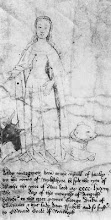
Here is a medieval drawing of St. Edmund. Edmund was king of East Anglia before England was united as one sovereign country. At the time, the British isle was subject to frequent and devastating raids by Vikings from Scandinavia. Usually the British people would pay tribute, or rather simply pay the Vikings off to avoid being pillaged. Edmund died a martyr. Imagine, a King of England dying for his Catholic faith.


St. Edmund, Martyr ~ Icon. You can see here the instruments of his martyrdom, the arrows. Also you see a wolf cradling a severed head. See next post for this story.
King of East Anglia, born about 840; died at Hoxne, Suffolk, 20 November, 870. The earliest and most reliable accounts represent St. Edmund as descended from the Wuffling line of preceding kings of East Anglia. Though only about fifteen years old when crowned on Christmas Day 855 by Bishop Humbert of Elmham. Edmund showed himself a model ruler from the first, anxious to treat all with equal justice, and closing his ears to flatterers and untrustworthy informers. In his eagerness for prayer he retired for a year to his royal tower at Hunstanton and learned the whole Psalter by heart, in order that he might afterwards recite it regularly. In 870 he bravely repulsed the two Danish chiefs Hinguar and Hubba who had invaded his dominions. They soon returned with overwhelming numbers, and pressed terms upon him which as a Christian he felt bound to refuse. In his desire to avert a fruitless massacre, he disbanded his troops and himself retired towards Framlingham; on the way he fell into the hands of the invaders. Having loaded him with chains, his captors conducted him to Hinguar, whose impious demands he again regjected, declaring his religion dearer to him than his life. His martyrdom took place in 870 at Hoxne in Suffolk.
After beating him with cudgels, the Danes tied him to a tree, and cruelly tore his flesh with whips. Throughout these tortures Edmund continued to call upon the name of Jesus, until at last, exasperated by his constancy, his enemies began to discharge arrows at him. This cruel sport was continued until his body had the appearance of a porcupine, when Hinguar commanded his head to be struck off. From his first burial-place at Hoxne his relics were removed in the tenth century to Beodricsworth, since called St. Edmundsbury, where arose the famous abbey of that name. His feast is observed 20 November, and he is represented in Christian art with sword and arrow, the instruments of his torture.

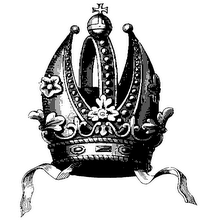
St. Edmund's ~ Coat of Arms

St. Edmund -Ora Pro Nobis!

(Source)