Monday, September 7, 2009

Theology of Human Suffering - Now Available


Our film company Our Lady's Tears Productions has completed our second venture, which I have posted about already. We were having some techincal difficulties with our site which have been corrected (more or less) so the documentary on human suffering can now be purchased. This is a 90 minute documentary about the rising prominence of the epidemics of sexually transmitted infections and obesity in a suffering American populace. Specifically this film examines the connection between loss of practice of Christian faith and the increase of these vices as a result. The film is made in a delicate enough manner that it can be shown to teens at home or Church CCD classes, etc. There are no offensive images whatsoever, but one of the topics is sexually transmitted diseases but no detail is discussed that would be considered provocative or shocking.


Also we have available for purchase a CD of the sountrack recorded locally for the short about the life of St. Germaine Cousin - Requiem of a Soul which is still in production. 100% of the monies made in the sale of the CD helps fund completion of this film. You can listen to a sample of the music here.

Sunday, September 6, 2009

Complete Consecration to Mary V


"I have said that this devotion could rightly be called a perfect renewal of the vows and promises of holy baptism. Before baptism every Christian was a slave of the devil because he belonged to him. At baptism he has either personally or through his sponsors solemnly renounced Satan, his seductions and his works. He has chosen Jesus as his Master and sovereign Lord and undertaken to depend upon him as a slave of love. This is what is done in the devotion I am presenting to you. We renounce the devil, the world, sin and self, as expressed in the act of consecration, and we give ourselves entirely to Jesus through Mary. We even do something more than at baptism, when ordinarily our god-parents speak for us and we are given to Jesus only by proxy. In this devotion we give ourselves personally and freely and we are fully aware of what we are doing.
In holy baptism we do not give ourselves to Jesus explicitly through Mary, nor do we give him the value of our good actions. After baptism we remain entirely free either to apply that value to anyone we wish or keep it for ourselves. But by this consecration we give ourselves explicitly to Jesus through Mary's hands and we include in our consecration the value of all our actions."

Source: St. Louis de Montfort's True Devotion to Mary

Saturday, September 5, 2009

Complete Consecration to Mary IV


"It follows then: that by this devotion we give to Jesus all we can possibly give him,and in the most perfect manner, that is, through Mary's hands. Indeed we give him far more than we do by other devotions which require us to give only part of our time, some of our good works or acts of atonement and penances. In this devotion everything is given and consecrated, even the right to dispose freely of one's spiritual goods and the satisfactions earned by daily good works. This is not done even in religious orders. Members of religious orders give God their earthly goods by the vow of poverty, the goods of the body by the vow of chastity, their free will by the vow of obedience, and sometimes their freedom of movement by the vow of enclosure. But they do not give him by these vows the liberty and right to dispose of the value of their good works. They do not despoil themselves of what a Christian considers most precious and most dear - his merits and satisfactions.
124. (2) It follows then that anyone who in this way consecrates and sacrifices himself voluntarily to Jesus through Mary may no longer dispose of the value of any of his good actions. All his sufferings, all his thoughts, words, and deeds belong to Mary. She can then dispose of them in accordance with the will of her Son and for his greater glory. This dependence, however, is without detriment to the duties of a person's present and future state of life. One such duty, for example, would be that of a priest who, by virtue of his office or otherwise, must apply the satisfactory or prayer value of the Holy Mass to a particular person. For this consecration can only be made in accordance with the order established by God and in keeping with the duties of one's state of life.
"


Source: St. Louis de Montfort from True Devotion to Mary

Friday, September 4, 2009

Complete Consecration to Mary III


"Note here that two things must be considered regarding our good works, namely, satisfaction and merit or, in other words, their satisfactory or prayer value and their meritorious value. The satisfactory or prayer value of a good work is the good action in so far as it makes condign atonement for the punishment due to sin or obtains some new grace. The meritorious value or merit is the good action in so far as it merits grace and eternal glory. Now by this consecration of ourselves to the Blessed Virgin we give her all satisfactory and prayer value as well as the meritorious value of our good works, in other words, all the satisfactions and the merits. We give her our merits, graces and virtues, not that she might give them to others, for they are, strictly speaking, not transferable, because Jesus alone, in making himself our surety with his Father, had the power to impart his merits to us. But we give them to her that she may keep, increase and embellish them for us, as we shall explain later, and we give her our acts of atonement that she may apply them where she pleases for God's greater glory."

Source: St. Louis de Montfort from True to Devotion to Mary

Wednesday, September 2, 2009

Complete Consecration to Mary II

St. Louis de Montfort

"This devotion consists in giving oneself entirely to Mary in order to belong entirely to Jesus through her. It requires us to give:
(1) Our body with its senses and members;
(2) Our soul with its faculties;
(3) Our present material possessions and all we shall acquire in the future;
(4) Our interior and spiritual possessions, that is, our merits, virtues and good actions of the past, the present and the future.
In other words, we give her all that we possess both in our natural life and in our spiritual life as well as everything we shall acquire in the future in the order of nature, of grace, and of glory in heaven. This we do without any reservation, not even of a penny, a hair, or the smallest good deed. And we give for all eternity without claiming or expecting, in return for our offering and our service, any other reward than the honour of belonging to our Lord through Mary and in Mary, even though our Mother were not - as in fact she always is - the most generous and appreciative of all God's creatures. "

Source: St. Louis de Montfort from True Devotion to Mary, Chapter 3

Tuesday, September 1, 2009

Prayer to the Angel who comforted Jesus in the Garden

Agony in the Garden by El Greco
Came across this BEAUTIFUL prayer at Acta Sanctorum and could not resist reposting it here.

I salute thee, holy Angel
who didst comfort my Jesus in His agony,
and with thee I praise
the most holy Trinity
for having chosen thee
from among all the holy Angels
to comfort and strengthen Him
who is the comfort and strength of all
that are in affliction.
By the honor thou didst enjoy
and by the obedience, humility and love
wherewith thou didst assist
the sacred Humanity of Jesus, my Savior,
when He was fainting for very sorrow
at seeing the sins of the world
and especially my sins,
I beseech thee to obtain for me
perfect sorrow for my sins;
deign to strengthen me
In the afflictions that now overwhelm me,
and in all the other trials,
to which I shall be exposed henceforth
and, in particular,
when I find myself in my final agony.
Amen+

Complete Consecration to Mary


In these troubled times we must cling to our Lady's skirts and pray daily to be hidden and protected beneath the holy mantle. I find my heart troubled by many things and I need to remind myself that all is in the hand of God and nothing is outside of His power. So therefore there is no reason to fear, pray, offer your works and sufferings and cling to Mary. With this in mind, I'm kicking off a new series on consecration to Mary which are simply excerpts from True Devotion to Mary by St. Louis de Montfort.

A complete consecration to Mary

"As all perfection consists in our being conformed, united and consecrated to Jesus it naturally follows that the most perfect of all devotions is that which conforms, unites, and consecrates us most completely to Jesus. Now of all God's creatures Mary is the most conformed to Jesus. It therefore follows that, of all devotions, devotion to her makes for the most effective consecration and conformity to him. The more one is consecrated to Mary, the more one is consecrated to Jesus.
That is why perfect consecration to Jesus is but a perfect and complete consecration of oneself to the Blessed Virgin, which is the devotion I teach; or in other words, it is the perfect renewal of the vows and promises of holy baptism. "

St. Louis de Montfort, from chapter three - True Devotion to Mary


(I am a big believer in taking "small bites" of spiritual readings to let them sink in slowly, in case you were wondering why I tend to present these things in series. If I don't read long blog postings, my assumption is most others dont either- thus the shorter "series" postings - God be with you)

Thursday, August 20, 2009

New Our Lady's Tears Production

THEOLOGY OF HUMAN SUFFERING DOCUMENTARY TRAILER from David James on Vimeo.


Our Lady's Tear's LLC has recently completed its second production - the trailer can be viewed above. This documentary is complimentary to our movie on the life of St. Germaine Cousin. This production examines our current society's problems with venereal disease and obesity as reflections of our growing Godlessness and lack of willingness to suffer, then presents the Catholic theology of redemptive suffering.

Tuesday, August 11, 2009

Prayers for the Sick VII


Queen of Martyrs and Mother of Compassion, by the unspeakable sorrow which brought thy heart to the lowest depths of desolation, when Jesus was laid in the sepulchre and thou couldst no more comfort thyself with the sight of His lifeless body, pray for this sick person, that, since human remedies are of no avail for them, they may, by thy powerful intercession, be cured, and thus we may, both in time and eternity, give thee heartful thanks.

Hail Mary...


V. Pray for him/her, most sorrowful Virgin

R. That he/she may be made worthy of the promises of Christ.


Oremus/Let us pray


GRANT, we beseech Thee, O Lord Jesus Christ, that the most blessed Virgin Mary Thy Mother, whose must holy sould was pierced with the sword of sorrow in the hour of Thy Passion, may intercede before the throne of Thy mercy for this Thy servant, now and at the hour of thier death. Who livest and reignest, world without end. Amen+

Monday, August 10, 2009

Prayers for the Sick VI


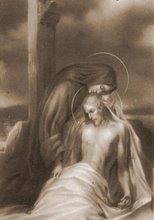
Queen of Martyrs and Mother of Compassion, by the bitter sorrow thou didst experience, when receiving on thy knees thy Jesus taken down from the cross, receive in thy loving arms this sick person, and moved by the sight of their suffering, restore to them the health of body and the peace of soul.

Hail Mary...

Amen+

Sunday, August 9, 2009

Prayers for the Sick V


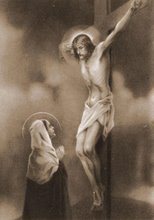
Queen of Martyrs and Mother of Compassion, by the unspeakable sorrow thou didst suffer, when thou didst behold thy Jesus hanging on the tree of the cross, with His hands and feet pierced with nails, and all His body covered with blood, regard the painful sufferings of this sick person, and relieve the pains of his/her body, procuring at the same time, through the merits of thy Son's most precious Blood, the salvation of his/her soul.

Hail Mary...

Amen+

Saturday, August 8, 2009

Prayers for the Sick IV

Teutonic nuns caring for the sick

Queen of Martyrs and Mother of Compassion, by the intense sorrow thou didst endure, when thou didst meet thy dear Son Jesus laden with a heavy cross, without being able to relieve Him, let the sight of this sick person, whom thou canst relieve, so move thee, that thou mayest deliver him/her from the burden of his/her illness.

Hail Mary...

Amen+

Friday, August 7, 2009

Prayers for the Sick III

Nuns caring for the sick at Hotel Dieu in Paris, c1482


Queen of Martyrs and Mother of Compassion, by the bitter sorrow thy most loving heart experienced, when in sorrow thou didst seek thy Son Jesus for three long days, obtain for this sick person perfect health of body and soul.


Hail Mary...


Amen+

Thursday, August 6, 2009

Prayers for the Sick II


Queen of Martyrs and Mother of Compassion, by the unspeakable sorrow thou didst experience, when obliged to flee into Egypt with the Child Jesus, obtain grace for the sick person we recommend to thee, that thy presence may be for the health of his/her body and soul.
Hail Mary...
Amen+

Wednesday, August 5, 2009

Prayers for the Sick

Hospitallers of the Order of St. John of Jerusalem caring for the sick
by Philippe Thomassin

I have been remiss as of late in posting and also in my poor efforts to promulgate devotion to Our Lady's Seven Sorrows. Thus begins the first of a new series of prayers for the sick through the intercession of our Sorrowful Mother. In these fine prayers we ask our Heavenly Mother to intercede upon the sick person's behalf in honor of her sorrows - a devotion which pleases Jesus very much. Following this series for the sick will be a series of prayers for the dying.

Prayers fo a Sick Person

Queen of Martyrs and Mother of Compassion, by the sword of sorrow which pierced thy soul, when holy Simeon foretold the most cruel Passion and death of thy beloved Son, obtain that the sick person for whom we pray may no more be tormented in his/her body, if it be for the greater good of his/her soul.

Hail Mary...

Amen+

Thursday, July 30, 2009

Holy Hearts


Dutch words: "Jesus, Mary, Joseph, I give you my heart. I give you my life."


Another treasure from Micki at Holy Cards for your Inspiration. I could not resist posting again here in honor of the holy hearts of Jesus and His earthly parents. Enjoy.

Tuesday, July 28, 2009

Catholic independant film company

"Our Lady's Tears"
Official logo commissioned by Matthew Alderman

Ok, my husband has been at me for awhile to post a link here to our new independant film company's website, not surprisingly named "Our Lady's Tears Productions" My husband and I prayerfully discerned our calling to found this company to make authentically Catholic films for wide distribution. Our first film is entitled Requiem of a Soul and is the life story of St. Germaine Cousin. Go HERE to view our newly launched website. We have completed a 30 min short film and plan to complete an entire feature length movie once we have the funds. A trailer can be viewed on the site.

I ask of you the following:

~ Please pray for our company

~ If you or anyone you know is interested in investing in Catholic film making, please contact us via our contact information on the site.

~ Please post links to our site on your blogs/websites/etc to help spread the word and hopefully generate interest.

Monday, July 6, 2009

Mary Gardens IV

More flowers which have a rich and beautiful tradition of symbolism of Mary's sorrows and tears. Go HERE for much, much more information. I went to this website and found also the following:


Mary's (torn) Tresses (of Hair)
- recalling the popular folk tradition that Mary tore out locks of her hair in her agonizing sorrow at the foot of the Cross.

Ladie's Tresses


(photo credit)

"This is one of Illinois' native and endangered orchids. This little orchid is only about 4 inches tall."

Maidenhair Fern


(photo credit)

Slim, grouped leaves which resemble tresses of a ladie's hair.


Yellow Bedstraw or Galium verum

Resembles clusters of blond hair. With this name, must have been used in medieval Europe as a bedding.

Asparagus Fern


The resemblance to long locks of hair for this plant is rather obvious.

Sunday, July 5, 2009

Mary Gardens III

More flowers depicting Mary's tears, which fell at the foot of her Son's cross. According to pious legend, there sprang from the earth flowers in the shape of tears. If you are a gardening sort, consider planting some of these flowers near your home in honor of Mary's Tears, shed on your behalf.


Job's Tears plant: Round tear-like seeds. Commonly used for stringing Rosary beads, and thus known also as Lagrimas de Rosario or Rosary Tears


Larkspur: tear-like buds


Sundew: tear-like drops of rain water on flower filaments


Lungwort: blue flower eyes, with reddish buds,

seen together to symbolize Mary's eyes red from crying.


Our Lady as she appeared to the seers of La Salette, France

Saturday, July 4, 2009

Mary Gardens II

Mary's Tears

This pious tradition comes to us from legends that flowers with tear-drop resemblance sprang up where Mary's tears fell on the ground at the foot of the Cross.


Virginia Spiderwort: blue tear-like fluid from spent blooms


Ladie's Mantle: drops of water remaining on leaves from rain


Lily of the Valley: small tear-like white blooms


Gromwell: A British common wildflower with small tear-like blooms


Quaking Grass: tear-like seed clumps


O Jesus, behold the tears of the one who loved Thee most on earth, and who loves Thee most ardently in heaven! Amen+

Friday, July 3, 2009

Mary Gardens

I have just recently discovered an old and beautiful tradition of honoring our Lady with what is known as a Mary Garden. This garden is grown with flowers said to represent the Blessed Virgin Mary. This practice is steeped in time and tradition. Here's more:

The Flowers of Mary's Sorrows

Most frequently grown in Mary Gardens are: Mary's Sword of Sorrow:


Iris with "spear like" foilage

(photo credit)

- from Simeon's prophecy to Mary at the Presentation of the Child Jesus in the Temple that her soul would be pierced by a sword that the thoughts of many hearts will be revealed.


"25And behold there was a man in Jerusalem named Simeon, and this man was just and devout, waiting for the consolation of Israel; and the Holy Ghost was in him.
26 And he had received an answer from the Holy Ghost, that he should not see death, before he had seen the Christ of the Lord. 27 And he came by the Spirit into the temple. And when his parents brought in the child Jesus, to do for him according to the custom of the law, 28 He also took him into his arms, and blessed God, and said: 29 Now thou dost dismiss thy servant, O Lord, according to thy word in peace; 30 Because my eyes have seen thy salvation,
31 Which thou hast prepared before the face of all peoples: 32 A light to the revelation of the Gentiles, and the glory of thy people Israel. 33 And his father and mother were wondering at those things which were spoken concerning him. 34 And Simeon blessed them, and said to Mary his mother: Behold this child is set for the fall, and for the resurrection of many in Israel, and for a sign which shall be contradicted; 35 And thy own soul a sword shall pierce, that, out of many hearts, thoughts may be revealed."


~Luke chapter 2 verses 25 to 35.


Amen+

Friday, June 26, 2009

Living Purgatory


"Blessed are those who are persecuted for righteousness’ sake, for theirs is the kingdom of heaven. Blessed are you when men revile you and persecute you and utter all kinds of evil against you falsely on my account. Rejoice and be glad, for your reward is great in heaven" (Matt 5:10-12)

Those who are seriously trying to live out the gospel and will not capitulate to the spirit of the world have every reason to expect persecution. It would be expected to meet with persecution from neighbors, co-workers, even family, but the place we would least expect this would be within our very own parishes. This is a most painful affliction indeed.

For where does one turn when their "heaven on earth" has become a living purgatory....or worse. Drive to another parish - 50, 100 or 150 miles? Stay and close your eyes tightly to the "innovations" thrust upon your weary soul? How does one close their ears? What of the scandal given to children? Stay and suffer with the Hidden Jesus? Change parishes? Stay? Go? Just because it valid does that mean we can do NOTHING that is beautiful? Nothing that is reverent?

O Lord, You once told Peter that one day he would be led where he did not want to go. Do Thou shepherd me Lord and save my ears and my eyes from all that offends Thee. Amen+

Thursday, June 25, 2009

The Narrow Gate

Virgin of Sorrows by Albrecht Durer
"Enter ye in at the narrow gate: for wide is the gate, and broad is the way that leadeth to destruction, and many there are who go in thereat. How narrow is the gate, and strait is the way that leadeth to life: and few there are that find it!" ~Matthew 7:13-14
How often we have heard these beautiful words of our Lord. How often we have heard that true devotion of Mary is the fastest, more sure, safest way to become closer to God? We need to turn to Mary, give her all of our selves, sparing nothing and place within her Immaculate Heart all our spiritual and temporal needs. It is within this sacred vessel that we shall oneday break upon the shores of salvation.
Dear Blessed Mother, I ask, wilt thou be for me
and my family the Narrow Gate which leads to Heaven?

Mary, Mother of Sorrows, Mother of God, be our salvation!

O Mater Dolorosa ~ Ora Pro Nobis! Amen+

Monday, June 22, 2009

Vengeance is Mine saith the Lord

( Photo credit)
Recently I had a dream that I saw a dump truck, or perhaps a garbage truck from far above. As it drove along, it looked like garbage was falling out from the back of it onto the road. As I came closer, I realized with horror that what was falling out were dismembered body parts of aborted babies. Then I looked at the ground and it was soaked thickly with blood, as far as my eye could see, the entire ground of the earth was soaked and flooded with dark, red blood.

This prayer I then uttered, or rather exclaimed to the Lord: "O Lord, is now the entire earth soaked with the blood of innocents? How it must cry to you for vengeance!"

How unfathomable is the mercy of the Lord that He would continue to send us rain, to grow our crops, to shine the sun upon us - even to allow us to continue to exist!

"Penance! Penance! Penance!"
~St. Bernadette Soubirous

PARDON PRAYER
MY GOD, I believe, I adore, I trust, and I love Thee!
I ask pardon for for those who do not believe, do not adore,
do not trust and do not love Thee.
~Angel of Portugal to the seers of Fatima

Saturday, June 13, 2009

St. Edmund, Martyr VI


(photo credit)


The High Altar at East Barsham Church, England, with the brightly coloured reredos depicting amongst them St. George, St Edmund King and Martyr and Our Lady of Walsingham.

From right to left: St. George, St. Winifred (?), St. Edmund, Our Lady of Walsingham, two unknown female saints and St. Thomas Becket. Anyone recognize the unnamed saints?
Henry VIII stopped here on his pilgrimage to the Shrine of Our Lady of Walsingham to pray for a son and would have heard Mass from this very church. Oddly enough it was this same King, who had once been named by the Holy Father "Defender of the Faith" who through his own lust broke with Rome to form his own church. What all know what a success this has been. I think it was Martin Luther who said "Every man has a pope in his belly." Ironic...

Friday, June 12, 2009

St. Edmund, Martyr V

St Edmund the Martyr crowned by angels
from a manuscript of Bury St Edmunds circa 1130
(photo credit)


No Christian can be surprised that innocence should suffer. Prosperity is often the most grievous judgment that God exercises upon a wicked man, who by it is suffered, in punishment of his impiety, to blind and harden himself in his evil courses, and to plunge himself deeper in iniquity. On the other hand God, in his merciful providence, conducts second causes so that afflictions fall to the share of those souls whose sanctification he has particularly in view. By tribulation a man learns perfectly to die to the world and himself, a work which, without its aid, even the severest self-denial and the most perfect obedience, leave imperfect. By tribulation we learn the perfect exercise of humility, patience, meekness, resignation, and pure love of God; which are neither practiced nor learned without such occasions. By a good use of tribulation a person becomes a saint in a very short time, and at a cheap rate. The opportunity and grace of suffering well is a mercy in favour of chosen souls; and a mercy to which every saint, from Abel to the last of the elect, is indebted for his crown. We meet with sufferings from ourselves, from disappointments, from friends, and from enemies. We are on every side beset with crosses. But we bear them with impatience and complaints. Thus we cherish our passions, and multiply sins by the very means which are given us to crucify and overcome them. To learn to bear crosses well is one of the most essential and most important duties of a Christian life. To make a good use of the little crosses which we continually meet with is the means of making the greatest progress in all virtue, and of obtaining strength to stand our ground under great trials. St. Edmund's whole life was a preparation for martyrdom.


Taken from Vol. III of "The Lives or the Fathers, Martyrs and Other Principal Saints" by the Rev. Alban Butler

Thursday, June 11, 2009

St. Edmund, Martyr IV

The Martydom of St Edmund. St Mary's Church, Bury St. Edmund, England
(photo credit)


The saint's head was carried by the infidels into a wood and thrown into a brake of bushes; but miraculously found by a pillar of light and deposited with the body at Hoxdon. These sacred remains were very soon after conveyed to Bedricsworth, or Kingston, since called St. Edmundsbury, because this place was St. Edmund's own town and private patrimony; not on account of his burial, for in the English-Saxon language signified a court or palace. A church of timber was erected over the place where he was interred, which was thus built according to the fashion of those times. Trunks of large trees were sawn lengthways in the middle and reared up with one end fixed in the ground, with the bark or rough side outermost. These trunks being made of an equal height and set up close to one another, and the interstices filled up with mud or mortar, formed the four walls, upon which was raised a thatched roof. Nor can we be surprised at the homeliness of this structure, since the same was the fabric of the royal rich abbey of Glastonbury, the work of the most munificent and powerful West-Saxon kings, till in latter ages it was built in a stately manner of stone. The precious remains of St. Edmund were honoured with many miracles. In 920, for fear of the barbarians under Turkil the Dane, in the reign of King Ethelred, they were conveyed to London by Alfun, bishop of that city, and the monk Egelwin, or Ailwin, the keeper of this sacred treasure, who never abandoned it. After remaining three years in the Church of St. Gregory, in London, it was translated again with honour to St. Edmundsbury in 923. The great church of timberwork stood till King Knute, or Canutus, to make reparation for the injuries his father Swein, or Sweno, had done to this place and to the relics of the martyr, built and founded there, in 1020, a new most magnificent church and abbey in honour of this holy martyr. The unparalleled piety, humility, meekness, and other virtues of St. Edmund are admirably set forth by our historians. This incomparable prince and holy martyr was considered by succeeding English kings as their special patron, and as an accomplished model of all royal virtues. The feast of St. Edmund is reckoned among the holidays of precept in this kingdom by the national council of Oxford in 1222; but is omitted in the constitutions of Archbishop Simon Islep, who retrenched certain holidays in 1362.


Taken from Vol. III of "The Lives or the Fathers, Martyrs and Other Principal Saints" by the Rev. Alban Butler

Wednesday, June 10, 2009

St. Edmund, Martyr III

Beautiful icon showing St. King Edmund with the instruments of his martyrdom: the arrow and sword.


The people, relying upon the faith of treaties, thought themselves secure, and were unprepared. However, the good king raised what forces he could, met the infidels, or at least a part of their army near Thetford, and discomfited them. But seeing them soon after reinforced with fresh numbers, against which his small body was not able to make any stand, and being unwilling to sacrifice the lives of his soldiers in vain, and grieving for the eternal loss of the souls of his enemies, who would be slain in a fruitless engagement, he disbanded his troops and retired himself towards his castle of Framlingham, in Suffolk. The barbarian had sent him proposals which were inconsistent both with religion and with the justice which he owed to his people. These the saint rejected, being resolved rather to die a victim of his faith and duty to God, than to do anything against his conscience and religion. In his flight he was over taken and surrounded by infidels at Oxon, upon the Waveney: he concealed himself for some short time, but, being discovered, was bound with heavy chains and conducted to the general's tent. Terms were again offered him equally prejudicial to religion and to his people, which the holy Icing refused to confirm, declaring that religion was dearer to him than his life, which he would never purchase by offending God. Hinguar, exasperated at this answer, in his barbarous rage caused him to be cruelly beaten with cudgels, then to be tied to a tree and torn a long time together with whips. All this he bore with invincible meekness and patience, never ceasing to call upon the name of Jesus. The infidels were the more exasperated, and as he stood bound to the tree, they made him a mark wantonly to shoot at, till his body was covered with arrows like a porcupine. Hinguar at length, in order to put an end to the butchery, commanded his head to be struck off. Thus the saint finished his martyrdom on the 20th of November, in 870, the fifteenth of his reign, and twenty-ninth of his age; the circumstances of which St. Dunstan learned from one who was armour-bearer to the saint and an eye-witness. The place was then called Henglesdun, now Hoxon, or Hoxne; a priory of monks was afterwards built there which bore the name of the martyr.


Taken from Vol. III of "The Lives or the Fathers, Martyrs and Other Principal Saints" by the Rev. Alban Butler

Tuesday, June 9, 2009

St. Edmund, Martyr II


The holy king had reigned fifteen years when the Danes infested his dominions. Hinguar and Hubba, two brothers, the most barbarous of all the Danish plunderers landing in England, wintered among the East-Angles; then, having made a truce with that nation, they in summer sailed to the north, and landing at the mouth of the Tweed, plundered with fire and sword Northumberland, and afterwards Mercia, directing their march through Lincolnshire, Northamptonshire, and Cambridgeshire. Out of a lust of rage and cruelty, and the most implacable aversion to the Christian name, they everywhere destroyed the churches and monasteries; and, as it were in barbarous sport, massacred all priests and religious persons whom they met with. In the great monastery of Coldingham, beyond Berwick, the nuns, fearing not death but insults which might be offered to their chastity, at the instigation of St. Ebba, the holy abbess, cut off their noses and upper lips, that appearing to the barbarians frightful spectacles of horror, they might preserve their virtue from danger; the infidels accordingly were disconcerted at such a sight, and spared their virtue, but put them all to the sword. In their march, amongst other monasteries, those of Bardney, Crowland, Peterborough, Ely, and Huntingdon were levelled with the ground, and the religious inhabitants murdered. In the Cathedral of Peterborough is shown a monument (removed thither from a place without the building) called Monks'-Stone, on which are the effigies of an abbot and several monks. It stood over the pit in which fourscore monks of this house were interred, whom Hinguar and Hubba massacred in 870. The barbarians, reeking with blood, poured down upon St. Edmund's dominions, burning Thetford, the first town they met with, and laying waste all before them.

Taken from Vol. III of "The Lives or the Fathers, Martyrs and Other Principal Saints" by the Rev. Alban Butler
St. Edmund, Martyr - Ora Pro Nobis!

Monday, June 8, 2009

St. Edmund Martyr I

St. Edmund is the third from the left in armor. Photo credit - aisle of St. Andrew's Church, Kimbolton, Cambridgeshire England


I know I did a series on this saint before, but can you learn too much about the lives of the saints? I don't think so...My own devotion to this saint grows stronger with each passing day and so I here wish to honor him. All my searching for a medal, picture or holy card of St. Edmund Martyr have proven fruitless. If you know of any, please contact me!


ST EDMUND, KING of ENGLAND AND MARTYR—A.D. 870
Feast: November 20


Though from the time of King Egbert, in 802, the Kings of the West-Saxons were monarchs of all England, yet several kings reigned in certain parts after that time, in some measure subordinate to them. One Offa was King of the East-Angles, who, being desirous to end his days in penance and devotion to Rome, resigned his crown to St. Edmund, at that time only fifteen years of age, but a most virtuous prince, and descended from the old English-Saxon kings of this isle. The saint was placed on the throne of his ancestors, as Lydgate, Abbo, and others express themselves, and was crowned by Humbert, Bishop of Elman, on Christmas Day, in 855, at Burum, a royal villa on the Stour, now called Bures, or Buers. Though very young, he was by his piety, goodness, humility, and all other virtues, the model of good princes. He was a declared enemy of flatterers and informers, and would see with his own eyes and hear with his own ears, to avoid being surprised into a wrong judgment, or imposed upon by the passions or ill designs of others. The peace and happiness of his people were his whole concern, which he endeavoured to establish by an impartial administration of justice and religious regulations in his dominions. He was the father of his subjects, particularly of the poor, the protector of widows and orphans, and the support of the weak. Religion and piety were the most distinguishing part of his character. Monks and devout persons used to know the psalter without book, that they might recite the psalms at work, in travelling, and on every other occasion. To get it by heart St. Edmund lived in retirement a whole year in his royal tower at Hunstanton (which he had built for a country solitude), which place is now a village in Norfolk. The book which the saint used for that purpose was religiously kept at St. Edmundsbury till the dissolution of abbeys.


Taken from Vol. III of "The Lives or the Fathers, Martyrs and Other Principal Saints" by the Rev. Alban Butler