Showing posts with label heroic virtue. Show all posts

Tuesday, January 27, 2009

The Way of Mortification


I have been wracking my simple mind lately about how to restrain my love of comforts. I simply love comfort - my comfortable bed, favorite foods, good wine, computer games...you name it I seek it if its comfortable. Trouble with this is, is hampers all my small efforts to grow in virtue. I have become a slave to my own desires for comfort and therefore am mired in this world. I am unsure if I even have the will to try to give up my comforts but turn instead to prayer asking and begging God to help me at least want to mortify my desires and senses. I came across this reading and plan to meditate upon it. I thought perhaps others may find it helpful as well.


"There is an old principle which goes: "Da mihi sanguinem et dabo tibi spiritum." Woe to those who are enemies of mortification and of the cross of Christ!
In one act of mortification one can practice many virtues, according to the different ends which one proposes in each act, as for example:
1. He who mortifies his body for the purpose of checking concupiscence, performs an act of the virtue of temperance.
2. If he does this, purposing thereby to regulate his life well, it will be an act of the virtue of prudence.
3. If he mortifies himself for the purpose of satisfying for the sins of his past life, it will be an act of justice.
4. If he does it with the intention of conquering the difficulties of the spiritual life, it will be an act of fortitude.
5. If he practices this virtue of mortification for the end of offering a sacrifice to God, depriving himself of what he likes, and doing that which is bitter and repugnant to nature, it will be an act of the virtue of religion.
6. If he intends by mortification to receive greater light to know the divine attributes, it will be an act of faith.
7. If he does it for the purpose of making his salvation more and more secure, it will be an act of hope.
8. If he denies himself in order to help in the conversion of sinners, and for the release of the poor souls in purgatory, it will be an act of charity towards his neighbor.
9. If he does it so as to help the poor, it will be an act of mercy.
10. If he mortifies himself for the sake of pleasing God more and more, it will be an act of love of God.
In other words, I shall be able to put all these virtues into practice in one act of mortification, according to the end I propose to myself while doing the said act.
Virtue has so much more merit, is more resplendent, charming and attractive, when accompanied by greater sacrifice.
Man, who is vile, weak, mean, cowardly, never makes a sacrifice, and is not even capable of doing so, for he never resists even one appetite or desire. Everything that his concupiscence and passions demand, he concedes, if it is in his power to yield or reject, for he is base and cowardly, and lets himself be conquered and completely overcome, just as the braver of two fighters conquers the cowardly one. So it is with vice and the vicious -- the latter is crushed and the slave of his vices. Continence and chastity are therefore worthy of the highest praise, because the man who practices purity refrains from the pleasure which proceeds from nature or passion. Thus, the greater merit will be his the greater the pleasure he has denied himself. His merit will be the greater in proportion to the amount of repugnance he will have in conquering himself, in proportion to the intense and prolonged suffering he will have to undergo, to the human respect he will have to vanquish, and to the sacrifices he will have to make. Let him do all this and suffer all for the love of virtue and for God's greater glory. As to my exterior deportment, I proposed to myself modesty and recollection and in the interior of my soul my aim was continual and ardent occupation in God. In my work I aimed at patience, silence and suffering. The exact accomplishment of the law of God and of the Church, the obligations of my state of life as prescribed by God. I tried to do good to others, flee from sin, faults and imperfections, and to practice virtue."


~Autobiography of St. Anthony Mary Claret

Thursday, September 4, 2008

Heroic Virtue IX - Final


Temperance, which restrains us when passions urge us to what is wrong, comprises becoming deportment, modesty, abstinence, chastity, sobriety, and others. Instances of heroic temperance: St. Joseph, St. John the Baptist.

Temperance is one of the four cardinal virtues. It may be defined as the righteous habit which makes a man govern his natural appetite for pleasures of the senses in accordance with the norm prescribed by reason. In one sense temperance may be regarded as a characteristic of all the moral virtues; the moderation it enjoins is central to each of them. It is also according to St. Thomas Aquinas a special virtue. Thus, it is the virtue which fights concupiscence or which controls the yearning for pleasures and delights which most powerfully attract the human heart. These fall mainly into three classes: some are associated with the preservation of the human individual; others with the perpetuation of the race, and others still with the well-being and comfort of human life.


Under this aspect temperance has for subordinate virtues, abstinence, chastity, and modesty. Abstinence prescribes the restraint to be employed in the partaking of foodand drink. Obviously the measure of this self-restraing is not constant and invariable. It is different for different persons as well as for different ends in view. The diet of an anchorite would not do for a farm labourer. Abstinence is opposed to the vices of gluttony and drunkenness. The disorder of these is that food and drink are made use of in such wise as to damage instead of benefit the bodily health. Hence gluttony and drunkenness are said to be intrinsically wrong. That does not mean, however, that they are always grievous sins. Gluttony is seldom such; drunkenness is so when it is complete, that is when it destroys the use of reason for the time being. Chastity as a part of temperance regulates the sensual satisfactions connected with the propagation of the human species. The contrary vice is lust. As these pleasures appeal with the special vehemence to human nature, it is the function of chastity to impose the norm of reason. Thus it will decide that they are altogether to be refrained from in obedience to a higher vocation or at any rate only availed of with reference to the purposes of marriage. Chastity is not fanaticism; much less is it insensibility. It is the carrying out of the mandate of temperance in a particular department where such a steadying power is acutely needed.


The virtue of modesty, as ranged under temperance, has as its task the holding in reasonable leash of the less violent human passions. It brings into service humility to set in order a man's interior. By transfusing his estimates with truth, and increasing his self-knowledge it guards him against the radical malice of pride. It is averse to pusillanimity, the product of low views and a mean-spirited will. In the government of the exterior of a man modesty aims to make it conform to the demands of decency and decorousness (honestas). In this way his whole outward tenor of conduct and method of life fall under its sway. Such things as his attire, manner of speech, habitual bearing, style of living, have to be made to square with its injunctions. To be sure the cannot always be settled by hard and fast rules. Convention will oftenhave a good deal to say in the case, but in turn will have its propriety determined by modesty. Other virtues are enumerated by St. Thomas as subordinate to temperance inasmuch as they imply moderation in the management of some passion. It ought to be noted, however, that in its primary and generally understood sense temperance is concerned with what is difficult for a man, not in so far as he is a rational being precisely, but rather in so far as he is an animal. The hardest duties for flesh and blood are self-restraint in the use of food and drink and of the venereal pleasures that go with the propagation of the race. That is why abstinence and chastity may be reckoned the chief and ordinary phases of this virtue. All that has been said receives additional force of we suppose that the self-control commanded by temperance is measured not only by the rule of reason but by the revealed law of God as well. It is called a cardinal virtue because the modration required for every righteous habit has in the practice of temperance a specially trying arena. The satisfactions upon which it imposes a check are at once supremely natural and necessary in the present order of human existence. It is not, however, the greatest of moral virtues. That rank is held by prudence; then come justice, fortitude, and finally temperance.

Thursday, August 28, 2008

Heroic Virtue VIII


Fortitude, which urges us on when difficulty stands in the way of our duty, is itself the heroic element in the practice of virtue; it reaches its apex when it overcomes obstacles which to ordinary virtue are insurmountable.

Fortitude as one of the gifts from the Holy Ghost is a supernatural virtue. It is what, as Christians, we must always have in mind in order to make our actions acceptable for eternal life. But we still keep hold upon the natural principles of fortitude as those whereon grace has to build. "Natural fortitude" could be said to be had for instance by those who disply courage in battle, even unto death for what is seen as a cause worth dying for. Non-Christians can possess this sort of fortitude and as such is of the ordinary form of virtue.

Christian fortitude is mainly not in war strictly so-called, but in moral courage against the evil spirit of the times, against improper fashions, against human respect, against the common tendency to seek at least the comfortable, if not the voluptuous. We need courage also to be patient under poverty or privation, and to make laudable struggles to rise in the social scale. It requires fortitude to mount above the dead level of average Christianity into the region of magnanimity, and if opportunity allow it, of magnificence, which are the allied virtues of fortitude, while another is perseverance, which tolerates no occasional remissness, still less occasional bouts of dissipation to relieve the strain of high-toned morality and religion.

Therefore, fortitude is attainable to every Christian. Heroic levels of fortutide, with God's grace may be won by simple housewives and mothers in the seemingly ordinariness of life. There is heroism in putting on a smile and wiping that nose for the 100th time today, in choosing to be patient against the will the rebels and wants to do anything, be anywhere but home with toddlers all day. The same could be said for anyone who works - who does not deal day in and day out with those who bother, pester and outright offend you? This brings to mind the "little way" of St. Therese the Little Flower:
"Without love, deeds, even the most brilliant, count as nothing."

"For one pain endured with joy, we shall love the good God more forever."

~St. Therese of Lisieux

Tuesday, August 26, 2008

Heroic Virtue VII

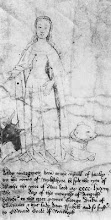
Painting of Lady Justice, Court of the Mercanzia in Florence, Author unknown: "With her large, gleaming sword and the celestial orb, over which, like any justice, she must reign forever."

Justice, which gives every one his due, is the pivot on which turn the virtues of religion, piety, obedience, gratitude, truthfulness, friendship, and many more. Jesus sacrificing His life to give God His due, Abraham willing to sacrifice his son in obedience to God's will, these are acts of heroic justice.

Justice is here taken in its ordinary and proper sense to signify the most important of the cardinal virtues. It is a moral quality or habit which perfects the will and inclines it to render to each and to all what belongs to them. Of the other cardinal virtues, prudence perfects the intellect and inclines the prudent man to act in all things according to right reason. Fortitude controls the irascible passions; and temperance moderates the appetites according as reason dictates. While fortitude and temperance are self-regarding virtues, justice has reference to others. Together with charity it regulates man's intercourse with his fellow men. But charity leads us to help our neighbour in his need out of our own stores, while justice teaches us to give to another what belongs to him.

Because man is a person, a free and intelligent being, created in the image of God, he has a dignity and a worth vastly superior to the material and animal world by which he is surrounded. Man can know, love, and worship his Creator; he was made for that end, which he can only attain perfectly in the future, immortal, and never-ending life to which he is destined. God gave him his faculties and his liberty in order that he might freely work for the accomplishment of his destiny. He is in duty bound to strive to fulfil the designs of his Creator, he must exercise his faculties and conduct his life according to the intentions of his Lord and Master. Because he is under these obligations he is consequently invested with rights, God-given and primordial, antecedent to the State and independent of it. Such are man's natural rights, granted to him by nature herself, sacred, as is their origin, and inviolable. Beside these he may have other rights given him by Church or State, or acquired by his own industry and exertion. All these rights, whatever be their source, are the object of the virtue of justice. Justice requires that all persons should be left in the free enjoyment of all their rights.

(source)

Thursday, August 21, 2008

Heroic Virtue VI


Simon VOUET Allegory of Prudence

[Allégorie de la Prudence]

Prudence, which enables us to know what to desire or to avoid, attains heroicity when it coincides with the "gift of counsel", i.e. a clear, Divinely aided insight into right and wrong conduct. As an example of heroic prudence we have St. Paschasius Radbert. About St. Paschasius is written: "So great was his prudence that from his mind a bourn of prudence seemed to flow. For he beheld together the past, the present, and the future, and was able to tell, by the counsel of God, what in each case was to be done"

It is to be observed that prudence, whilst possessing in some sort an empire over all the moral virtues, itself aims to perfect not the will but the intellect in its practical decisions. Its function is to point out which course of action is to be taken in any round of concrete circumstances. It indicates which, here and now, is the golden mean wherein the essence of all virtue lies. It has nothing to do with directly willing the good it discerns. That is done by the particular moral virtue within whose province it falls. Prudence, therefore, has a directive capacity with regard to the other virtues. It lights the way and measures the arena for their exercise. The insight it confers makes one distinguish successfully between their mere semblance and their reality. It must preside over the eliciting of all acts proper to any one of them at least if they be taken in their formal sense. Thus, without prudence bravery becomes foolhardiness; mercy sinks into weakness, and temperance into fanaticism. But it must not be forgotten that prudence is a virtue adequately distinct from the others, and not simply a condition attendant upon their operation. Its office is to determine for each in practice those circumstances of time, place, manner, etc. which should be observed, and which the Scholastics comprise under the term medium rationis. So it is that whilst it qualifies immediately the intellect and not the will, it is nevertheless rightly styled a moral virtue. (source)

From the Summa Theologica of St. Thomas Aquinas regarding prudence and the gift of counsel:

"Prudence or euboulia (deliberating well), whether acquired or infused, directs man in the research of counsel according to principles that the reason can grasp; hence prudence or euboulia (deliberating well) makes man take good counsel either for himself or for another. Since, however, human reason is unable to grasp the singular and contingent things which may occur, the result is that "the thoughts of mortal men are fearful, and our counsels uncertain" (Wisdom 9:14). Hence in the research of counsel, man requires to be directed by God who comprehends all things: and this is done through the gift of counsel, whereby man is directed as though counseled by God, just as, in human affairs, those who are unable to take counsel for themselves, seek counsel from those who are wiser." (Source)

Thursday, August 14, 2008

Heroic Virtue V

The Charity of St. Elizabeth of Hungary
by Edmund Blair Leighton (1853-1922)

St. Elizabeth is one of my many patron saints whose name for me is synonymous with the word and virtue of charity. Today she is best remembered for her charitable works, especially for the establishment of hospitals. Today, dozens of hospitals and medical centers are named for her, several of them founded by the Sisters of St. Francis. Elizabeth lived at a time when the combined disasters of climate, war, pestilence, and poverty caused great suffering, and she became devoted to helping those who had nowhere to turn.

Elizabeth was born in Hungary in 1207. Her short but fruitful life lasted 24 years; she passed away in Marburg, Germany on November 17, 1231. November 17 is the feast day of St. Elizabeth celebrated by the Church.

She began life as part of the Hungarian nobility, daughter of King Andrew II. At age 14, she married the 21-year-old Ludwig IV, of Thuringia (Germany).

Read more about St. Elizabeth here.

Charity

Defintion from American Heritage Dictionary:
  1. Provision of help or relief to the poor; almsgiving.
  2. Something given to help the needy; alms.
  3. An institution, organization, or fund established to help the needy.
  4. Benevolence or generosity toward others or toward humanity.
  5. Indulgence or forbearance in judging others. See Synonyms at mercy.
  6. often Charity Christianity The theological virtue defined as love directed first toward God but also toward oneself and one's neighbors as objects of God's love.

Charity inclines man to love God above all things with the love of friendship. The perfect friend of God says with St. Paul: "With Christ I am nailed to the cross. And I live, now not I; but Christ liveth in me" (Galatians 2:19-20). For love means union. Its type in heaven is the Divine Trinity in Unity; its highest degree in God's creatures is the beatific vision, participation in God's life in Heaven.

On earth charity is the fruitful mother of holiness, the one thing necessary, the one all-sufficient possession. It is extolled in I Cor., xiii, and in St. John's Gospel and Epistles; the beloved disciple and the fiery missionary of the cross are the best interpreters of the mystery of love revealed to them in the Heart of Jesus. With the commandment to love God above all Jesus coupled another: "And the second is like to it: Thou shalt love thy neighbor as thyself. There is no other commandment greater than these" (Mark 12:31).

The likeness, or the linking of the two commandments, lies in this: that in our neighbor we love God's image and likeness, His adopted children and the heirs of His Kingdom. Hence, serving our neighbor is serving God. And the works of spiritual and temporal mercy performed in this world will decide our fate in the next: "Come, ye blessed of my Father, possess you the kingdom. . .For I was hungry, and you gave me to eat. . . Amen I say to you, as long as you did it to one of these my least brethren, you did it to me" (Matthew 25:34-40). For this reason the works of charity in heroic degree have been, from the beginning to this day, a distinctive mark of the Catholic Church, the pledge of sanctity in countless numbers of her sons and daughters.

(Excerpts taken from Catholic Encyclopedia)

Monday, August 11, 2008

Heroic Virtue IV

This is "the rack" of medieval England infamy. This terrible instrument of torture was used to kill one St. Nicholas Owen, here is his brief story which I pray will demonstrate how martyrdom is a perfect example of the theological, and certainly heroic virtue of HOPE:

Saint Nicholas was probably the most important person in the preservation of Catholicism in England during the period of the penal laws against the faith. He was a carpenter or builder, who saved the lives of countless Jesuit priests in England for two decades by constructing hiding places for them in mansions throughout the country. He became a Jesuit lay brother in 1580, was arrested in 1594 with Father John Gerard, and despite prolonged torture would not give the names of any of his Catholic colleagues; he was released on the payment of a ransom by a wealthy Catholic.

Brother Nicholas is believed to have been responsible for Father Gerard's dramatic escape from the Tower of London in 1597.

Nicholas was arrested a third time in 1606 with Father Henry Garnet, whom he had served 18 years, Father Edward Oldcorne, and Father Oldcorne's servant, Brother Ralph Ashley. He refused to give any information concerning the Gunpowder Plot. They were imprisoned in the Tower of London. Nicholas was subjected to such vicious torture, which literally tore his body to pieces, killing him.

Nicholas was also known as Little John and Little Michael and used the aliases of Andrews and Draper.

Born in Oxford, England; died in the Tower of London, 1606; beatified in 1929; canonized by Pope Paul VI in 1970 as one of the Forty Martyrs of England and Wales; feast day formerly March 12.


Hope, the second theological virtue we will examine is a firm trust that God will give us eternal life and all the means necessary to obtain it; it attains heroicity when it amounts to unshakeable confidence and security in God's help throughout all the untoward events of life, when it is ready to forsake and sacrifice all other goods in order to obtain the promised felicity of heaven. Such hope has its roots in a faith equally perfect. Abraham, the model of the faithful, is also the model of the hopeful "who against hope believed in hope. . .and he was not weak in faith; neither did he consider his own body now dead.. nor the dead womb of Sara" (Romans 4:18-22).

The virtue of heroic hope especially comes to life for us when we examine the lives and particularly the deaths of the martyrs. They gave their lives rather than compromise their faith and thus exchange finite and perishable earthly life for infinite and eternal life with God in heaven. I cannot say this for certain, but I suspect that from hope springs perseverance, the kind which prevents us from falling into apostasy when faced with persecution. For Catholics this is commonly transmitted to us through the actual grace of God in the holy sacrament of Confirmation.

As an aside, did you know that confirmation places upon your souls an indelible seal? This seal cannot be removed by anything and goes with each soul either into heaven, or hell. I can only imagine that in heaven this serves only to increase your share in Christ's glory, but in hell it shall serve to increase that poor soul's suffering for all eternity.

"Beloved, do not be surprised that a trial by fire is occurring among you, as if something strange were happening to you. But rejoice to the extent that your share in the sufferings of Christ, so that when his glory is revealed you may also rejoice exultantly. If you are insulted for the name of Christ, blessed are you, for the Spirit of Glory and of God rests upon you. But let no one among you be made to suffer as a murderer, a thief, an evildoer, or as an intriguer. But whoever is made to suffer as a Christian should not be ashamed but glorify God because of the name. For it is time for the judgment to begin with the household of God; if it begins with us, how will it end for those who fail to obey the gospel of Christ? 'And if the righteous one is barely saved, where will the godless and the sinner appear?' As a result, those who suffer in accord with God's will hand their souls over to a faithful creator as they do good." (1 Peter 4:12-19)

Sunday, August 10, 2008

Heroic Virtue III

St. Monica with her son St. Augustine of Hippo, whom God converted through her mother's perseverance in prayer for the conversion of his life of dissipation and heresy. When I think of models of heroic virtue, St. Monica always shines forth in my mind.

The few who become saints in this life are the heroes of virtue, the candidates for the honors of the altar, the saints on earth -who become the canonized saints of heaven after death.

Together with the four cardinal virtues the Christian saint must be endowed with the three theological virtues, especially with Divine charity, the virtue which informs, baptizes, and consecrates, as it were, all other virtues; which unifies them into one powerful effort to participate in the Divine life. Found in the Church's exhaustive investigation, the "proofs of heroicity" are required in the process of beatification.

As charity stands at the summit of all virtues, so faith stands at their foundation. For by faith God is first apprehended, and the soul lifted up to supernatural life. Faith is the secret of one's conscience; to the world it is made manifest by the good works in which it lives, "Faith without works is dead" (James 2:2). Such works are:

1. The external profession of faith

2. Strict observance of the Divine commands

3. Prayer

4. Filial devotion to the Church

5. The fear of God

6. The horror of sin

7. Penance for sins committed

8. Patience in adversity

All or any of these attain the grade of heroicity when practiced with unflagging perseverance, during a long period of time, or under circumstances so trying that by them men of but ordinary perfection would be deterred from acting. Martyrs dying in torments for the Faith, missionaries spending their lives in propagating it, the humble poor who with infinite patience drag out their wretched existence to do the will of God and to reap their reward hereafter, these are heroes of the Faith.

Read the list above, read them again, copy them down and post them where you can see them every day, study them, strive to live them, pray to God to help you attain each and every one. If you lack the strength, the courage, even the will - ask God for these things as well. He will order all things unto your sainthood if you ask Him too. It is His holy will that we all become saints. Amen+

Excerpts taken from Catholic Encyclopedia


Monday, August 4, 2008

We must perservere

"Remain firm, like the anvil under the hammer. The good athlete must take punishment in order to win. And above all we must bear with everything for God, so that he in turn may bear with us. Increase your zeal. Read the signs of the times. Look for him who is outside time, the eternal one, the unseen who became visible for us…" —St. Ignatius of Antioch, Letter to Polycarp, The Liturgy of the Hours, Vol III, pg. 564-565

Friday, August 1, 2008

Heroic Virtue II

St. Thomas Aquinas
Philosopher, theologian, Doctor of the Church (Angelicus Doctor)
Patron of Catholic universities, colleges, and schools
Born at Rocca Secca in the Kingdom of Naples, 1225 or 1227
Died at Fossa Nuova, 7 March, 1274

Heroic virtue is the possession of saints and a great gift from the Almighty, attained after a time of purification. Such a degree of virtue belongs only to souls already purified from all attachment to worldly things, but strongly attached to God. St. Thomas (I-II:61:4) says:

"Virtue consists in the following, or imitation, of God. Every virtue, like every other thing, has its type [exemplar] in God. Thus the Divine mind itself is the type of prudence; God using all things to minister to His glory is the type of temperance, by which man subjects his lower appetites to reason; justice is typified by God's application of the eternal law to all His works; Divine immutability is the type of fortitude. And, since it is man's nature to live in society, the four cardinal virtues are social [politicae] virtues, inasmuch as by them man rightly ordains his conduct in daily life. Man, however, must raise himself beyond his natural life unto a life Divine: 'Be you therefore perfect, as also your heavenly Father is perfect' (Matthew 5:48). It is, therefore, necessary to posit certain virtues midway between the social virtues, which are human, and the exemplary virtues, which are Divine. These intermediate virtues are of two degrees of perfection: the lesser in the soul still struggling upwards from a life of sin to a likeness with God -- these are called purifying virtues [virtutes purgatoriae]; the greater in the souls which have already attained to the Divine likeness -- these are called virtues of the purified soul [virtutes jam purgati animi]. In the lesser degree, prudence, moved by the contemplation of things Divine, despises all things earthly and directs all the soul's thought unto God alone; temperance relinquishes, as far as nature allows, the things required for bodily wants; fortitude removes the fear of departing this life and facing the life beyond; justice approves of the aforesaid dispositions. In the higher perfection of souls already purified and firmly united with God, prudence knows nothing but what it beholds in God; temperance ignores earthly desires; fortitude knows nothing of passions; justice is bound to the Divine mind by a perpetual compact to do as it does. This degree of perfection belongs to the blessed in heaven or to a few of the most perfect in this life."

Thursday, July 31, 2008

Heroic Virtue I

Adoration of the Mystic Lamb by Ghent. 1432.

So just what is heroic virtue? We know a person must have this to become a saint.

Benedict XIV described heroic virtue thus:

"In order to be heroic a Christian virtue must enable its owner to perform virtuous actions with uncommon promptitude, ease, and pleasure, from supernatural motives and without humanself-abnegation and full control over his natural inclinations."

An heroic virtue, then, is a habit of good conduct that has become a second nature, a new motive power stronger than all corresponding inborn inclinations, capable of rendering easy a series of acts each of which, for the ordinary man, would be beset with very great, if not insurmountable, diffulties. (source)

What this means is, in short - practice makes perfect. The older I get the more respect I have for those old sayings...they bear the wisdom of the ages. Heroic virtue is attainable, through God's good graces to every man, woman and child. We should all pray to become saints and to practice virtue in every small thing. When we fail, that is what confession is for.