Showing posts with label saints. Show all posts

Wednesday, November 4, 2009

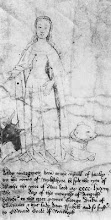
St. Dymphna


Our second daughter has recently, or should I say finally - has chosen her Confirmation saint. After listening each night to her prayer intention to choose between St. Germaine Cousin and St. Dymphna. I am uncertain why this is her choice, but I am confident in her prayerful discernment. She has so many very numerous patron saints - St. Lucy, St. Claire, St. Rose of Lima, St. Anne, St. Bernadette, St. Catherine of Alexandria (whom she is named after) and St. Germaine Cousin...just to name a few - but for some reason she is especially close to St. Dymphna. I suspect its because my daughter is somewhat of a princess and Dymphna is the patron of princesses, or maybe its the heroic virture in being a virgin martyr. I can tell you she's not nervous or mentally ill - nor is anyone in our family - so go figure.

So welcome to the family St. Dymphna! Ora pro nobis!


Thursday, December 11, 2008

For all those abused by those whose duty it is to care...


"Once in winter her stepmother, Hortense, accused her of stealing bread, and threatened to beat her with a stick. Germaine opened her apron, and summer flowers tumbled out. Neighbors and her parents were awed and began to treat her as a holy person. Her parents invited her to rejoin the household, but Germaine chose to live as she had."

There are far too many children who become the victims of those who ought to care for them. This is a great evil. Our culture of death, so in love with contraception and abortion, has become calloused. Child abuse is one of the many rotten fruits of the devil.

I wish to offer this post along with my small prayers through the intercession of St. Germaine Cousin - the patron of abused children.

Lord I beg you to hear the cries of the little ones who through no fault of their own, suffer the wickedness and cruelty of those who should be loving them. Lord, let the sound of my supplication ascend to your ears. I recommend each suffering soul to your Divine and Infinite Mercy. Release them from the bondage of abuse, the victims as well as the perpetrators. Lord, let my cry come unto You, I beg you to heal the heart and soul of the little one of whom I have had recent contact, do not allow any more abuse for this child. Heal her soul Lord and make of her and her sister great saints! Do not allow this injustice to offend You any longer, for all sins are committed against Thee. Lord have mercy. Amen+


"In 1601 she was found dead on her straw pallet under the stairs, and she was buried in the Church of Pibrac opposite the pulpit. When accidentally exhumed in 1644 during a renovation, her body was found incorrupt."


~ Picture of St. Germaine Cousin's incorrupt body

Documents attest to more than 400 miracles or extraordinary graces through the intervention of Saint Germain. They include cures of every kind (of blindness, both congenital and resulting from disease, of hip and spinal disease), and the multiplication of food for the distressed community of the Good Shepherd at Bourges in 1845.

Read more about this incredible saint here and here.

Monday, November 24, 2008

St. Winifred


Statue of St. Winifred, in this Catholic parish of St. Winifred, Pittsburgh PA.
Catholic Mom of 10 has a great post about St. Winifred's shrine in Wales. I hope she posts more specifics about her pilgrimmage there. It is truly one of my goals in life to visit this holy well. Go here for more information. And here is a prayer to St. Winifred:
O blessed Winefride, pure virgin and glorious martyr, so especially chosen, so divinely graced and so wonderfully restored from death to life! Hope of all that fly unto thee with full confidence and humility! We, though, unworthy, yet thy devoted pilgrims, make our petitions unto thee. Sanctuary of piety, look upon us with patient eyes; receive our prayers, accept our offerings, and present our supplications at the throne of mercy, that through thy powerful intercessions God may be pleased to bless our pilgrimage, and to grant our requests and desires; through Christ our Lord. Amen +
To learn more about this beautiful saint's life go here, here, and here
St. Winifred, my beloved patron saint, ora pro nobis!

Saturday, July 12, 2008

Virgin and Martyr

This is the effigy of St. Maria Goretti which is situated directly upon the spot where Allesandro Serinelli killed her. She was found my Serinelli's father upon the floor, right here. Maria was unconscious, but still alive following 14 stab wounds inflicted upon her as she resisted being raped. Her murderer had been harassing Maria for months prior to this event, trying to get Maria to give into his impure desires. She always and unfailingly resisted. Finally Alessandro would have his way and would not take no for an answer. As she resisted, he wrestled this 12 year old girl to the floor, with the knife poised over her head, she was given a choice, death or sin. She chose the better part.

At times in prayer, in spirit I go this place and kneel upon the cold stone floor. Here beside the place of Maria's triumph, I try to give honor to this heroic virgin martyr and beseech her prayers on my behalf. I entrust my and my family's purity to her prayers. I pray that given the same choice, death or sin, that her prayers will enable us to make the same choice.

Saint Maria Goretti - Ora Pro Nobis! Amen+

Sunday, June 15, 2008

St. Edward the Confessor

Anglo Saxon King of England 1042 - 1066
Royal House of Wessex
Canonized 1161
Patron saint of kings
Place of burial: Westminster Abbey, London England

Edwardus Rex - Ora Pro Nobis!

Thursday, January 10, 2008

Self-annihilation III

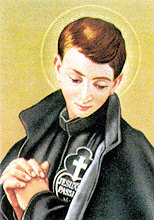
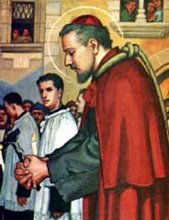
St. Benedict Joseph Labre

He set forward on his life's journey clad in an old coat, a rosary about his neck, another between his fingers, his arms folded over a crucifix which lay upon his breast. In a small wallet he carried a Testament, a breviary, which it was his wont to recite daily, a copy of the "Imitation of Christ", and some other pious books. Clothing other than that which covered his person he had none. He slept on the ground and for the most part in the open air. For food he was satisfied with a piece of bread or some herbs, frequently taken but once a day, and either provided by charity or gotten from some refuse heap. He never asked for alms and was anxious to give away to the poor whatever he received in excess of his scanty wants.

The first seven of the thirteen remaining years of his life were spent in pilgrimages to the more famous shrines of Europe. He visited in this way Loreto, Assisi, Naples, Bari, Fabriano in Italy; Einsiedeln in Switzerland; Compostella in Spain; Parav-le-Monial in France. The last six years he spent in Rome, leaving it only once a year to visit the Holy House of Loreto. His unremitting and ruthless self-denial, his unaffected humility, unhesitating obedience and perfect spirit of union with God in prayer disarmed suspicion not unnaturally aroused as to the genuineness of a Divine call to so extraordinary a way of existence. Literally worn out by his sufferings and austerities, on the 16th of April 1783, he sank down on the steps of the church of Santa Maria dei Monti in Rome and, utterly exhausted, was carried to a neighboring house where he died. His death was followed by a multitude of unequivocal miracles attributed to his intercession. The life written by his confessor, Marconi, an English version of which bears the date of 1785, witnesses to 136 miraculous cures as having been certified to up to 6 July, 1783. So remarkable, indeed, was the character of the evidence for some of the miracles that they are said to have had no inconsiderable part in finally determining the conversion of the celebrated American convert, Father John Thayer, of Boston who was in Rome at the time of the saint's death.

Benedict was proclaimed Venerable by Pius IX in 1859 and canonized by Leo XIII 8 December, 1881. His feast is kept on the 16th of April, the day of his death.

(source) The Catholic Encyclopedia, Volume II. Published 1907. New York: Robert Appleton Company. Nihil Obstat, 1907. Remy Lafort, S.T.D., Censor. Imprimatur. +John M. Farley, Archbishop of New York.

Tuesday, January 8, 2008

Self-annihilation II


After the heroic death of his uncle during an epidemic in September 1766, Benedict, who had dedicated himself during the scourge to the service of the sick and dying, returned to Amettes in November of the same year. His absorbing thought at this time was still to become a religious at La Trappe, and his parents fearing that further opposition would be resistance to the will of God fell in with his proposal to enter the cloister. It was suggested, how ever, by his maternal uncle, the Abbé Vincent, that application be made to the Carthusians at Val-Sainte-Aldegonde rather than to La Trappe. Benedict's petition at Val-Sainte-Aldegonde was unsuccessful but he was directed to another monastery of the same order at Neuville. There he was told that as he was not yet twenty there was no hurry, and that he must first learn plain-chant and logic. During the next two years he applied twice unsuccessfully to be received at La Trappe and was for six weeks as a postulant with the Carthusians at Neuville, he finally sought and obtained admission to the Cistercian Abbey of Sept-Fonts in November, 1769. After a short stay at Sept-Fonts during which his exactness in religious observance and humility endeared him to the whole community, his health gave way, and it was decided that his vocation lay elsewhere. In accordance with a resolve formed during his convalescence he then set out for Rome. From Chieri in Piedmont he wrote to his parents a letter which proved to be the last they would ever receive from him. In it he informed them of his design to enter some one of the many monasteries in Italy noted for their special rigor of life. A short time, however, after the letter was dispatched he seems to have had an internal illumination which set at rest forever any doubts he might have as to what his method of living was to be. He then understood "that it was God's will that like St. Alexis he should abandon his country, his parents, and whatever is flattering in the world to lead a new sort of life, a life most painful, most penitential, not in a wilderness nor in a cloister, but in the midst of the world, devoutly visiting as a pilgrim the famous places of Christian devotion". He repeatedly submitted this extraordinary inspiration to the judgment of experienced confessors and was told he might safely conform to it. Through the years that followed he never wavered in the conviction that this was the path appointed for him by God.

(Source) The Catholic Encyclopedia, Volume II. Published 1907. New York: Robert Appleton Company. Nihil Obstat, 1907. Remy Lafort, S.T.D., Censor. Imprimatur. +John M. Farley, Archbishop of New York.

More in next post! BTW, I don't post it all in one LONG post because I, myself do not read LONG posts on blogs so I figure many others do the same. My preference is smaller bites of information to be taken in over longer periods of time. Hope you don't mind this method. May Mary's prayers go with you always. Amen+
Monday, January 7, 2008

Self-annihilation I


Here starts a new series. I've been reading, that is...when I can pry it from my dear husband, a book on the subject of the interior life of souls. I'll post more on the book later. The part that spiked my interest especially was a portion on self annilhilation. First off, the term is very interesting, as I have a strong tendancy to be attracted to the radical side of Catholicism - I want it all, not just a little, not just a taste of Catholicism, I want the whole meal, dessert and all. Yep, that's me. In case you were wondering, I also fall far short of the ideals sainthood and interior perfection. In fact, the more I read holy books, the more I'm convinced that I have no virtue at all. Anyway - I found a saint I'd not heard of previously who is held up as THE model of self annilhilation. Here's his story...

St. Benedict Joseph Labre

Born: 26 March, 1748 at Amettes in the Diocese of Boulogne, France;

Died in Rome 16 April, 1783.

He was the eldest of fifteen children. His parents, Jean-Baptiste Labre and Anne-Barba Grandsire, belonged to the middle class and so were able to give to their numerous offspring considerable opportunities in the way of education. His early training he received in his native village in a school conducted by the vicar of the parish. The account of this period furnished in the life written by his confessor, Marconi, and that contained in the one compiled from the official processes of his beatification are at one in emphasizing the fact that he exhibited a seriousness of thought and demeanor far beyond his years. Even at that tender age he had begun to show a marked predilection for the spirit of mortification, with an aversion for the ordinary childish amusements, and he seems from the very dawning of reason to have had the liveliest horror for even the smallest sin. All this we are told was coexistent with a frank and open demeanor and a fund of cheerfulness which remained unabated to the end of his life.
At the age of twelve his education was taken over by his paternal uncle, François-Joseph Labre, curé of Erin, with whom he then went to live. During the six following years which he spent under his uncle's roof, he made considerable progress in the study of Latin, history, etc. but found himself unable to conquer a constantly growing distaste for any form of knowledge which did not make directly for union with God. A love of solitude, a generous employment of austerities and devotedness to his religious exercises were discernible as distinguishing features of his life at this time and constitute an intelligible prelude to his subsequent career.
At the age of sixteen he resolved to embrace a religious life as a Trappist, but having on the advice of his uncle returned to Amettes to submit his design to his parents for their approval he was unable to win their consent. He therefore resumed his sojourn in the rectory at Erin, redoubling his penances and exercises of piety and in every way striving to make ready for the life of complete self-annihilation to which the voice within his soul seemed to be calling him.
The Catholic Encyclopedia, Volume II. Published 1907. New York: Robert Appleton Company. Nihil Obstat, 1907. Remy Lafort, S.T.D., Censor. Imprimatur. +John M. Farley, Archbishop of New York
More in next post!