Friday, October 10, 2008
Stay Awake!
Thursday, October 9, 2008
Catholic England V - St. Edmund, Martyr

"Entirely medieval in spirit though are the inscriptions at the top of the scene. Around Edmund’s head, angelic hands (the one at the left clearer) hold a continuous scroll. Only the word ‘Edmund’ to the left of the tree’s foliage is readable, but the rest of the sentence probably identified him fully as martyred King of the East Angles. The second scroll on the right, curving around the head, shoulders and elbow of the upper right-hand archer, reads ‘Heven blyß to his mede, hym s[h]all have for hys gud de[de]...’. "
Tuesday, October 7, 2008
Catholic England IV - St. Edmund, Martyr


After giving the head and body a speedy burial, the kingdom rebuilt itself for several years before finally erecting a church worthy of Edmund's burial. Legend told that upon exhumation of the body, a miracle was discovered. All the arrow wounds upon Edmund's corpse were healed and his head reattached to his body. The only evidence of his previous decapitation was a thin, red line around his neck. Despite being buried for many years in a flimsy coffin, his skin was soft and fresh as if he were merely sleeping the entire time.
In Percy Dearmer's The Little Lives of the Saints, we are told of Edmund's posthumous revenge on the Danes:
“...the last heathen Danish king, Sweyen (the father of Canute), tried to destroy (Bury St Edmunds). He laid siege to it, and demanded all the treasure of the church, else he threatened to destroy the church and kill all the clergy; and this he said with many taunting words about the saint who lay buried there. But as he was sitting on his war–horse, waiting to attack the town, he saw in the sky St Edmund coming towards him, a crown on his head and a long bright lance in his hand. 'Help, friends!' he cried. 'Edmund is coming to kill me!' Then he fell down, and died in convulsions.”
Sweyn's son, King Canute, converted to Christianity and rebuilt the abbey at Bury St Edmunds. In 1020, he made a pilgrimage there and offered his own crown upon the shrine as atonement for the sins of his forefathers.
Monday, October 6, 2008
Catholic England III - St. Edmund, Martyr

This is by far my favorite image of St. Edmund martyr from the famous "Wilton Diptych" This post will focus on this beautiful and moving piece of art. If you are a total nerd like me who loves the Catholic church and her saints, medieval English history and art - this post is for you! :)
From Wikipedia: "The Wilton Diptych (c.1395-1399) is a small portable altarpiece of two panels. It is an extremely rare survival within England of late Medieval religious painting.
The diptych was painted for King Richard II of England who is depicted kneeling before the Virgin and Child in what is known as a "votive portrait".
The painting is considered an outstanding example of the International Gothic style and possibly of English art. It belongs to the National Collection and is currently housed in the National Gallery, London."
Here is entire left side of the diptych:
"... the kneeling King Richard II is presented by the Saints John the Baptist, Edward the Confessor and Edmund the Martyr. In the right hand panel the Virgin Mary with the Christ Child in her arms is surrounded by eleven angels, against a golden background and field of delicately coloured flowers."
Interpretation: The identity of the kneeling king is known because the angels surrounding the Virgin are wearing the livery of Richard II, the White Hart, which also appears in the brocade of the left panel and the outside of the diptych. As Richard kneels, the Christ Child reaches towards him in benediction and also reaches towards the pennant held by an angel, and significantly placed between them. This pennant is the symbol of Richard's kingship and of the Kingdom of England as a whole, It bears the Cross of St. George, the symbol of England and furthermore surmounting the staff is an orb on which is tiny map of England.
All three saints who present the kneeling Richard to the Virgin and Child are believed to have been venerated by the king, as each has his own chapel in Westminster Abbey. Each saint holds the symbollic attribute by which they are recognised in art. Edmund the Martyr, who stands to the left, holds the arrow which killed him in 869, while Edward the Confessor, at the centre, holds the ring he gave to a pilgrim who transpired to be the disguised John the Evangelist. John the Baptist (right) holds his symbol, the Lamb of God.
The image on the left makes reference to King Richard's birth on 6th January. This is the feast day that Christians celebrate Epiphany, when Christ was adored by three kings and also the baptism of the adult Christ with John the Baptist shown touching Richard's shoulder.
John the Baptist was Richard's Patron Saint, and Saint Edward and Saint Edmund had both been English kings. Richard had a special devotion to Edmund, who with St. George is one of the patron saints of England.
The painting is indicative of both Richard's belief in his divine right to rule and his genuine Christian devotion. It also importantly symbolises (in the form of the Pennant), Richard II giving his kingdom into the hands of the Holy Virgin, thereby continuing a long tradition by which England was known as "Our Lady's Dowry" and was thought to be specially under her protection
(source)
Friday, October 3, 2008
Catholic England II - St. Edmund, Martyr

"King Edmund stood within his hall of the mindful Healer with Hinguar (Ivar), who then came, and discarded his weapons. He willed to imitate Christ's example, which forbade Peter to fight against the fierce Jews with weapons. Lo! to the dishonorable man Edmund then submitted and was scoffed at and beaten by cudgels. Thus the heathens led the faithful king to a tree firmly rooted in Earth, tightened him thereto with sturdy bonds, and again scourged him for a long time with straps. He always called between the blows with belief in truth to Christ the Saviour."
The king's body was ultimately interred at Beadoriceworth, the modern Bury St Edmunds. The shrine of Edmund soon became one of the most famous and wealthy pilgrimage locations in England and the reputation of the saint became universal.
(photo credit) The date of Edmund's canonization is unknown, although Hermann's Life of Edmund, written in the late eleventh century, states that it happened in the reign of Athelstan (924–939). Edmund's popularity among the English nobility was lasting. It is known that his banner was borne in the Irish expedition of the Anglo-Normans and also when Caerlaverock Castle was taken in 1300. A banner with Edmund's crest was also carried at the battle of Agincourt. Churches dedicated to his memory are found all over England, including St Edmund the King and Martyr in London. There are a number of colleges named after St Edmund. His shrine at Bury St Edmunds was destroyed in 1539, during the English Reformation. His feast day is 20 November.

The Abbey of St Edmund at Bury
Next posts will be about the famous Wilton image and the fascinating "Legend of St. Edmund"
Thursday, October 2, 2008
Catholic England I - St. Edmund, Martyr
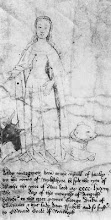
Here is a medieval drawing of St. Edmund. Edmund was king of East Anglia before England was united as one sovereign country. At the time, the British isle was subject to frequent and devastating raids by Vikings from Scandinavia. Usually the British people would pay tribute, or rather simply pay the Vikings off to avoid being pillaged. Edmund died a martyr. Imagine, a King of England dying for his Catholic faith.
St. Edmund, Martyr ~ Icon. You can see here the instruments of his martyrdom, the arrows. Also you see a wolf cradling a severed head. See next post for this story.St. Edmund -Ora Pro Nobis!
(Source)
Save Us From the Fires of Hell VIII

Save Us From the Fires of Hell VII

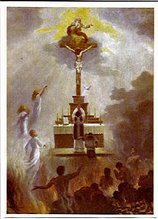
We know the fate of those who are unfortunate enough to die in a state of mortal sin is hellfire. What of the torments that accompany the fire? The saints can tell us much of the plethora of sufferings that await the damned.
St. Thomas Aquinas tells us that the sins of each one will be fully known to all other inhabitants of hell. Our sins will be fully visible in our bodies - we can imagine how horrible this would be. Can you think of what things would be more painful in this life than to live in open shame? That all around you, everyone knew of all your "hidden" sins and shameful acts?
The evil one will brand each reprobate with a mark of shame on each portion of thier body with which they sinned. This is in order that all shameful deeds may be known to all. This is the everlasting disgrace which God foretells of through His prophet: "I will bring an everlasting reproach upon you, and a perpetual shame which shall never be forgotten." (Jer. xxiii 40) No effort will erase the mark, nothing may be used with which to cover it. According to St. Ephrem: "This shame and infamy will be more insupportable than the hell-fire itself, because it will keep constantly before thier remembrance the sins whereby they defiled themselves on earth."
Dionysius the Carthusian writes about a mystical transportation which occured to his fellow religious. The monks pressed thier fellow for a detailed account of what he'd seen. This was dutifully recorded and ought to serve us well as a reminder of our need to avoid mortal sin: "I was conducted by my guide a long way until we came to a region of gloom and horror, where were a countless multitude of men and women, all suffering terrible torments. These were the persons who had sinned with thier bodies; they were plagued by huge fiery monsters, who sprang upon them, and, despite thier resistance, clasped them and hugged them with thier paws until they shrieked with pain. Amongst those who were tormented in this manner I saw a man whom I knew very well, and who had been much esteemed and respected in the world. Seeing me he cried aloud in piteous tones "Alas, alas! Woe is me that I sinned as I did in my lifetime, for now the pain I endure grows greater every day! But the worse of all , what I feel most acutely, is the shame and disgrace to which my sins expose me, for all know them, and all despise me and mock me on account of them."
Think a moment, would you rather not become ill with a terrible illness than become the object of public scorn, shame and ridicule? Would you rather not carry in your body a terrible suffering than be openly mocked and treated with derision on account of your sins?
Just as hell is only one mortal sin away, so is grace only one confession away. Do not delay one more day. If you are embarassed to confess some secret sin - confess it anyway! Do it and be healed by Jesus - ask for the grace and strength to not commit it again. Any brief moment of embarassment in confessing such a thing behind a screen is nothing compared with multitudes knowing every shame you've committed and mocking you for all eternity without respite! Go to a priest and be healed and delivered from such a fate!
O sweet Jesus, whose overflowing charity for men is requited by so much forgetfulness, negligence and contempt, behold us prostrate before Thy altar eager to repair by a special act of homage the cruel indifference and injuries, to which Thy loving Heart is everywhere subject.
Monday, September 29, 2008
Save Us From the Fires of Hell V

"O Simon Magus! O disciples of his!
Saturday, September 27, 2008
Save Us From the Fires of Hell IV
Friday, September 26, 2008
Save Us From the Fires of Hell VI

Why on earth is it a good idea to think about, let alone meditate on hell?? The answer is simple - in order to avoid it. If we open our minds to the reality of this horrible place, and that we are only one mortal sin away from hell, we are more highly motivated to avoid sin & practice virtue. In our little struggles and strivings toward God, He who is Holy and Immortal will kindly bend Himself to us and pour His gracious love into our souls and strengthen it against the powers of hell. He will grant us the ability to avoid hell if we seek Him. "Seek and ye shall find, knock and it shall be opened unto you."
If we were perfect, we would love God for His own sake - this is the ideal we strive for. BUT - fear of hell is a good start on the spiritual path, so let us attempt to instill in our hearts a holy and reverent fear of hell. Seek God who we pray will kindle in us great faith and a lively hatred of all sin.
One of my favorite books, The Four Last Things (Fr. Martin von Cochem, O.S.F.C. TAN Books) provides many excellent meditations on hell:
"According to St. Bridget 'The heat of hell-fire is so great that if the whole world were wrapped in flames, the heat of the conflagration would be as nothing in comparison with it.'...Remember this O sinner and lay it well to heart. When thou seest a fire, call to mind the fire of hell. And since thou couldst not endure to put thy hand for a single moment into that fire, think what the heat of hell-fire must be..if thou canst bear this, how will thou bear the other? The damned will one day be cast body and soul into the huge awful furnace of hell, into the immense lake of fire, where they will be surrounded by flames. There will be fire below them, fire above them, fire all around them. Every breath will be a scorching breath of a furnace. These infernal flames will penetrate every portion of the body, so that there will be no part or member, within or without, that is not steeped in fire.
How despairing will be the cries, how agonizing the shrieks that will ascend from this bed of torture! 'Woe to us miserable creatures! Woe to us a thousand times! We are tortured in this flame! The excruciating pain pervades every member of our body, the intolerable agony leaves us no rest! If only we could die, if only we could die so as to escape this horrible torture! Alas this wish is all in vain! Dead as far as the life of the soul is concerned, dead because we have forfieted grace, the mercy of God-we are condemned to live on, to live forever and ever!"
We must pray for God's mercy on that fateful last day of Judgement. We must pray and pray for the conversion of poor sinners whose fate lies in those awful flames. Have pity on your fellow man who knows not of the mercy and love of God - who is at such great risk of casting himself headlong into the flames of hell when he sees with the eyes of his soul how rotten with sin he is at his particular judgement. Invoke our Blessed Lady, entrust yourself to her - she saves more souls from hell than we can know is this life!
Prayer
Hail O Resurrection of mankind; Hail o Downfall of the demons! Hail O you who crushed the error of deceit; Hail O you who exposed the fraud of idols! Hail O Bride, and Maiden ever pure! O Thou who are Immaculate, destined before all time to be the Holy Tabernacle of the New Covenant - Ora Pro Nobis Maria!
Wednesday, September 24, 2008
Save Us From the Fires of Hell III
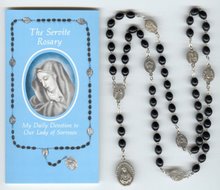
Bl. Mary of Agreda was a visionary of the Blessed Virgin Mary who had a great devotion to Our Lady's Sorrows. Our Sorrowful Mother often requested of the Servant of God her prayers for the dying, telling her of what torments and perils souls undergo just prior to death. "There are sinners in their last agony who have but a few moments in which to save their souls from eternal perdition." Many souls fight their last battle, trying to keep hold of the graces obtained in a devout and holy life, others are in great danger of losing their final battle. The evil one comes upon them, ladening upon them his rage, beseiging the soul with untold of temptations, especially the temptation to despair in reminding them of thier past sins and unworthiness of forgiveness. These things united with the suffering of death burden the soul greatly.Tuesday, September 23, 2008
Save Us From the Fires of Hell II
Born into Italian nobility and became a Priest, theological teacher and founder. He lived in constant danger working with the sick during a cholera epidemic. He was also a highly successful fund-raiser for charities for the poor. St. Vincent founded guilds for workers, agricultural schools, loan associations, orphanages and homes for the destitute. This saintly priest felt a strong calling to bring Christ to Muslims, and founded a program to incorporate lay people in the apostolate of priests. He founded the Pious Society of Missions (Pallottines) for urban mission work. He also started the special observance of the Octave of Epiphany for the reunion of the Eastern and Roman Churches, and the return of the Church in England. (Source: Catholic Forum Saints Index)
Save Us From the Fires of Hell...
Monday, September 22, 2008
Great Article

Thursday, September 18, 2008
We must stand firm in hope.

On attacks against priests

A PRAYER FOR PRIESTS
Keep them, I pray Thee, dearest Lord, Keep them, for they are Thine -
Thy priests whose lives burn out before Thy consecrated shrine.
Keep them, for they are in the world, Though from the world apart;
When earthly pleasures tempt, allure, - Shelter them in Thy heart.
Keep them, and comfort them in hours Of loneliness and pain,
When all their life of sacrifice For souls seems but in vain.
Keep them, and O remember, Lord, They have no one but Thee,
Yet they have only human hearts, With human frailty.
Keep them as spotless as the Host. That daily they caress;
Their every thought and word and deed, Deign, dearest Lord, to bless.
Imprimatur: +D. Card. Dougherty, Arch. of Philadelphia
A perfect prayer

Monday, September 15, 2008
Novena for Life

Inspired by this confidence, I fly unto thee,
Amen.
Feast of Our Lady of Sorrows

Monday, September 8, 2008
We Must Repent

"For thus says the LORD: Indeed, I will deliver you to terror, you and all your friends. Your own eyes shall see them fall by the sword of their enemies. All Judah I will deliver to the king of Babylon, who shall take them captive to Babylon or slay them with the sword." ~Jeremiah 20:4
Are we not being delivered to terror? Does any nation who legally condones the willfull murder of the most innocent deserve to exist? Who shall be America's Babylon? And what of Canada and Europe? We who have for the most part forsaken our Christian roots and beliefs, O where has the faith of our father's gone?
We must as a nation repent, or we shall pass through the door of Christ's judgment.
Thursday, September 4, 2008
Heroic Virtue IX - Final

Temperance is one of the four cardinal virtues. It may be defined as the righteous habit which makes a man govern his natural appetite for pleasures of the senses in accordance with the norm prescribed by reason. In one sense temperance may be regarded as a characteristic of all the moral virtues; the moderation it enjoins is central to each of them. It is also according to St. Thomas Aquinas a special virtue. Thus, it is the virtue which fights concupiscence or which controls the yearning for pleasures and delights which most powerfully attract the human heart. These fall mainly into three classes: some are associated with the preservation of the human individual; others with the perpetuation of the race, and others still with the well-being and comfort of human life.
The virtue of modesty, as ranged under temperance, has as its task the holding in reasonable leash of the less violent human passions. It brings into service humility to set in order a man's interior. By transfusing his estimates with truth, and increasing his self-knowledge it guards him against the radical malice of pride. It is averse to pusillanimity, the product of low views and a mean-spirited will. In the government of the exterior of a man modesty aims to make it conform to the demands of decency and decorousness (honestas). In this way his whole outward tenor of conduct and method of life fall under its sway. Such things as his attire, manner of speech, habitual bearing, style of living, have to be made to square with its injunctions. To be sure the cannot always be settled by hard and fast rules. Convention will oftenhave a good deal to say in the case, but in turn will have its propriety determined by modesty. Other virtues are enumerated by St. Thomas as subordinate to temperance inasmuch as they imply moderation in the management of some passion. It ought to be noted, however, that in its primary and generally understood sense temperance is concerned with what is difficult for a man, not in so far as he is a rational being precisely, but rather in so far as he is an animal. The hardest duties for flesh and blood are self-restraint in the use of food and drink and of the venereal pleasures that go with the propagation of the race. That is why abstinence and chastity may be reckoned the chief and ordinary phases of this virtue. All that has been said receives additional force of we suppose that the self-control commanded by temperance is measured not only by the rule of reason but by the revealed law of God as well. It is called a cardinal virtue because the modration required for every righteous habit has in the practice of temperance a specially trying arena. The satisfactions upon which it imposes a check are at once supremely natural and necessary in the present order of human existence. It is not, however, the greatest of moral virtues. That rank is held by prudence; then come justice, fortitude, and finally temperance.
Thursday, August 28, 2008
Heroic Virtue VIII

Tuesday, August 26, 2008
Confession Holy Card
French translation: "I shall penetrate your heart with a great abhorrence of sin."Heroic Virtue VII
Painting of Lady Justice, Court of the Mercanzia in Florence, Author unknown: "With her large, gleaming sword and the celestial orb, over which, like any justice, she must reign forever."Justice is here taken in its ordinary and proper sense to signify the most important of the cardinal virtues. It is a moral quality or habit which perfects the will and inclines it to render to each and to all what belongs to them. Of the other cardinal virtues, prudence perfects the intellect and inclines the prudent man to act in all things according to right reason. Fortitude controls the irascible passions; and temperance moderates the appetites according as reason dictates. While fortitude and temperance are self-regarding virtues, justice has reference to others. Together with charity it regulates man's intercourse with his fellow men. But charity leads us to help our neighbour in his need out of our own stores, while justice teaches us to give to another what belongs to him.
Because man is a person, a free and intelligent being, created in the image of God, he has a dignity and a worth vastly superior to the material and animal world by which he is surrounded. Man can know, love, and worship his Creator; he was made for that end, which he can only attain perfectly in the future, immortal, and never-ending life to which he is destined. God gave him his faculties and his liberty in order that he might freely work for the accomplishment of his destiny. He is in duty bound to strive to fulfil the designs of his Creator, he must exercise his faculties and conduct his life according to the intentions of his Lord and Master. Because he is under these obligations he is consequently invested with rights, God-given and primordial, antecedent to the State and independent of it. Such are man's natural rights, granted to him by nature herself, sacred, as is their origin, and inviolable. Beside these he may have other rights given him by Church or State, or acquired by his own industry and exertion. All these rights, whatever be their source, are the object of the virtue of justice. Justice requires that all persons should be left in the free enjoyment of all their rights.
(source)
Friday, August 22, 2008
Queen of Heaven

Thursday, August 21, 2008
Heroic Virtue VI

Thursday, August 14, 2008
Heroic Virtue V
St. Elizabeth is one of my many patron saints whose name for me is synonymous with the word and virtue of charity. Today she is best remembered for her charitable works, especially for the establishment of hospitals. Today, dozens of hospitals and medical centers are named for her, several of them founded by the Sisters of St. Francis. Elizabeth lived at a time when the combined disasters of climate, war, pestilence, and poverty caused great suffering, and she became devoted to helping those who had nowhere to turn.
Elizabeth was born in Hungary in 1207. Her short but fruitful life lasted 24 years; she passed away in Marburg, Germany on November 17, 1231. November 17 is the feast day of St. Elizabeth celebrated by the Church.
Read more about St. Elizabeth here.
- Provision of help or relief to the poor; almsgiving.
- Something given to help the needy; alms.
- An institution, organization, or fund established to help the needy.
- Benevolence or generosity toward others or toward humanity.
- Indulgence or forbearance in judging others. See Synonyms at mercy.
- often Charity Christianity The theological virtue defined as love directed first toward God but also toward oneself and one's neighbors as objects of God's love.
Charity inclines man to love God above all things with the love of friendship. The perfect friend of God says with St. Paul: "With Christ I am nailed to the cross. And I live, now not I; but Christ liveth in me" (Galatians 2:19-20). For love means union. Its type in heaven is the Divine Trinity in Unity; its highest degree in God's creatures is the beatific vision, participation in God's life in Heaven.
On earth charity is the fruitful mother of holiness, the one thing necessary, the one all-sufficient possession. It is extolled in I Cor., xiii, and in St. John's Gospel and Epistles; the beloved disciple and the fiery missionary of the cross are the best interpreters of the mystery of love revealed to them in the Heart of Jesus. With the commandment to love God above all Jesus coupled another: "And the second is like to it: Thou shalt love thy neighbor as thyself. There is no other commandment greater than these" (Mark 12:31).
The likeness, or the linking of the two commandments, lies in this: that in our neighbor we love God's image and likeness, His adopted children and the heirs of His Kingdom. Hence, serving our neighbor is serving God. And the works of spiritual and temporal mercy performed in this world will decide our fate in the next: "Come, ye blessed of my Father, possess you the kingdom. . .For I was hungry, and you gave me to eat. . . Amen I say to you, as long as you did it to one of these my least brethren, you did it to me" (Matthew 25:34-40). For this reason the works of charity in heroic degree have been, from the beginning to this day, a distinctive mark of the Catholic Church, the pledge of sanctity in countless numbers of her sons and daughters.
(Excerpts taken from Catholic Encyclopedia)
Monday, August 11, 2008
Great Video
I thank God for each and very Catholic who is logical, informed and says "yes" to the call to defend our faith so well. Deo Gratias!
Heroic Virtue IV
This is "the rack" of medieval England infamy. This terrible instrument of torture was used to kill one St. Nicholas Owen, here is his brief story which I pray will demonstrate how martyrdom is a perfect example of the theological, and certainly heroic virtue of HOPE:Saint Nicholas was probably the most important person in the preservation of Catholicism in England during the period of the penal laws against the faith. He was a carpenter or builder, who saved the lives of countless Jesuit priests in England for two decades by constructing hiding places for them in mansions throughout the country. He became a Jesuit lay brother in 1580, was arrested in 1594 with Father John Gerard, and despite prolonged torture would not give the names of any of his Catholic colleagues; he was released on the payment of a ransom by a wealthy Catholic.
Brother Nicholas is believed to have been responsible for Father Gerard's dramatic escape from the Tower of London in 1597.
Nicholas was arrested a third time in 1606 with Father Henry Garnet, whom he had served 18 years, Father Edward Oldcorne, and Father Oldcorne's servant, Brother Ralph Ashley. He refused to give any information concerning the Gunpowder Plot. They were imprisoned in the Tower of London. Nicholas was subjected to such vicious torture, which literally tore his body to pieces, killing him.
Nicholas was also known as Little John and Little Michael and used the aliases of Andrews and Draper.
Born in Oxford, England; died in the Tower of London, 1606; beatified in 1929; canonized by Pope Paul VI in 1970 as one of the Forty Martyrs of England and Wales; feast day formerly March 12.
Hope, the second theological virtue we will examine is a firm trust that God will give us eternal life and all the means necessary to obtain it; it attains heroicity when it amounts to unshakeable confidence and security in God's help throughout all the untoward events of life, when it is ready to forsake and sacrifice all other goods in order to obtain the promised felicity of heaven. Such hope has its roots in a faith equally perfect. Abraham, the model of the faithful, is also the model of the hopeful "who against hope believed in hope. . .and he was not weak in faith; neither did he consider his own body now dead.. nor the dead womb of Sara" (Romans 4:18-22).
The virtue of heroic hope especially comes to life for us when we examine the lives and particularly the deaths of the martyrs. They gave their lives rather than compromise their faith and thus exchange finite and perishable earthly life for infinite and eternal life with God in heaven. I cannot say this for certain, but I suspect that from hope springs perseverance, the kind which prevents us from falling into apostasy when faced with persecution. For Catholics this is commonly transmitted to us through the actual grace of God in the holy sacrament of Confirmation.
As an aside, did you know that confirmation places upon your souls an indelible seal? This seal cannot be removed by anything and goes with each soul either into heaven, or hell. I can only imagine that in heaven this serves only to increase your share in Christ's glory, but in hell it shall serve to increase that poor soul's suffering for all eternity.
"Beloved, do not be surprised that a trial by fire is occurring among you, as if something strange were happening to you. But rejoice to the extent that your share in the sufferings of Christ, so that when his glory is revealed you may also rejoice exultantly. If you are insulted for the name of Christ, blessed are you, for the Spirit of Glory and of God rests upon you. But let no one among you be made to suffer as a murderer, a thief, an evildoer, or as an intriguer. But whoever is made to suffer as a Christian should not be ashamed but glorify God because of the name. For it is time for the judgment to begin with the household of God; if it begins with us, how will it end for those who fail to obey the gospel of Christ? 'And if the righteous one is barely saved, where will the godless and the sinner appear?' As a result, those who suffer in accord with God's will hand their souls over to a faithful creator as they do good." (1 Peter 4:12-19)