Showing posts with label self annihilation. Show all posts

Wednesday, January 30, 2008

Annihilation of Self X - Final


"St. Peter in Prison" (1631) by famous Dutch artist Rembrandt van Rijn (1606-1669).

"In all great temptations against purity, or against faith or hope, what is most painful to us is not exactly our fear of offending God, but our fear of losing ourselves through offending Him. We are much more occupied with the thought of our own interest than of His glory. This is why our confessor has so much difficulty in reassuring us, and in making us obey him. We think he is deceiving us, that he is leading us astray, that he is ruining us, because he requires us to pass over and set aside our vain fears. Let us annihilate our own judgment; let us prefer blind obedience to all else; let us even consent, if it is necessary, to be lost through obedience: then we shall find that all our perplexities, all the anguish of our soul, all our interior torments, will cease. We shall find peace, and a most exquisite and perfect peace, in the total forgetfullness of ourselves. There is nothing in heaven, or on earth, or in hell, that can trouble the peace of a soul that is really annihilated."
(Source: Manual for Interior Souls by Fr. Grou. 3rd Ed. St. Anselm's Society, London. 1905.)

There ends the chapter. Is there anything in this world that is better than inner peace? I think not. I hope you have learned as much as I have, perhaps more. I am not so bright really and have no virtue.
I was reminded of a story I read about St. Padre Pio - he had suffered for many years with a terrible and large hernia. Others had noticed he was having great difficulty ascending the stairs to the altar to say Mass. He literally had to stagger up them sideways as flexing his thigh put too much pressure on the hernia. One of his many spiritual children, a surgeon, was speaking to him one day after mass and the Saint said "Oh, I keep forgetting....I have something you need to look at." In another room, the doctor found Pio to have a huge, strangulating inguinal hernia at an advanced state. When the doctor asked Pio how long this had been going on, his reply went something like this: "Years I think, the Lord didn't cause me to remember to tell anyone." St. Pio was so self-annihilated that he gave no thought whatsoever to his own body, screaming though it was in agony.

Lord, lead me on the path of desolation. May I be one whom You look upon and find dead to self. May I consider You, before considering me. I cannot do this alone God, for I am a wicked and selfish soul indeed. Give me to know that I am nothing Lord, and what is it that nothing requires? Amen+

Tuesday, January 29, 2008

Annihilation of Self IX


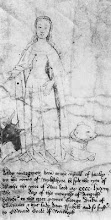
Alessandro Botticelli. Calumny of Apelles. c.1494-1495. Tempera on panel. Galleria degli Uffizi, Florence, Italy


Topic ~ Pride, the opposite of self annihilation.


"In all contempt we may have to suffer, in all calumnies and humiliations, the thing which really hurts us and really makes them hard to bear is our own pride; it is because we wish to be esteemed and considered, and treated with a certain respect, and that we do not at all like the idea of being treated with ridicule and contempt by others. This is what really agitates us, and makes us indignant, and renders our life bitter and insupportable. Let us set seriously to work to annilhilate ourselves, let us give no food to pride, let us put away from us all the first movements of self-esteem and self-love, and let us accept patiently and joyfully, in the depth of our soul, all the little mortifications which are offered to us. Little by little we shall come not to care in the very least about what is thought of us or said of us, or how we are treated. A person who is dead feels nothing; for him there is no more honour or reputation; praise and blame to him are equal."


"In the service of God, the cause of most of the trouble we experience is that we do not annihilate ourselves sufficiently in His Divine presence; it is because we have a sort of life which we try to preserve in all our dealings with Him; it is because we allow a secret pride to insinuate itself into our devotion. Hence it comes that we are not indifferent, as we ought to be, as to whether we are in dryness or in consolation; that we are very unhappy when God seems to withdraw from us, that we exhaust ourselves in desires and efforts to call Him back to us, and fall into the most wretched depression and desolation if His absence lasts a long time."


"From this cause too preceeds all our false alarms about the state of our souls. We think God must be angry with us because He deprives us of the sweetness of sensible devotion. We think our Communions have been bad because we have made them without relish; the same with our spiritual reading, our prayer, all our other practices of piety."


"Let us serve God, once for all, in the spirit of annihilation; let us serve Him for Himself alone, not for ourselves; let us sacrifice our own interests for His glory and His good pleasure; then we shall always be quite contented with the way in which He treats us, being persuaded that we deserve nothing, and that He is too good, I do not say to accept, but to permit our services."

(Source: Manual for Interior Souls by Fr. Grou. 3rd Ed. St. Anselm's Society, London. 1905.)


Truly a radical thought by todays standards in our "self-esteem" culture. We have truly become and perverse and most wretched generation, a people too distracted and caught up in ourselves that we do not see God's will in most things. We must strive always and in all things to deny ourselves, become dead to ourselves so that we may serve God, know Him and love Him as we ought. Amen+

Thursday, January 24, 2008

Annihilation of Self VIII

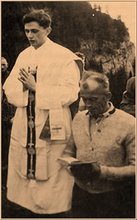
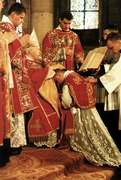
(Catholic priestly ordination)

Topic ~ Fruits of Self Annihilation

"I may add that this way of annihilation, against which nature cries out so strongly, is not really so painful as we imagine, and it is even sweet. For, first of all, our Lord and Savior Jesus Christ has said so. "Take My yoke upon you," He says, "for it is easy and light." However heavy this yoke may be in itself, God will lighten it to those who willingly take it up, and who consent to bear it for the love of Him. Love does not prevent us from suffering, but it makes us love our sufferings and prefer them to all pleasures."

"The reward, even in this world, of annihilating ourselves, is a peace of heart, a calm in our passions, a cessation of all the agitations of our mind, of all murmurs of interior revolts."

"Let us examine the proof of this in detail. What is the greatest evil of suffering? It is not the suffering itself, but it is our rebellion against it, it is the state of interior revolt which so often accompanies it. A soul that is perfectly annihilated will suffer all the evils imaginable without losing the sweet repose of its blessed state: this is a matter of experience. It costs a great deal to attain to this state of annihilation, we must make the greatest efforts over ourselves; but when we have once attained it we enjoy a peace and repose proportionate to the victories we have gained. The habit of renouncing ourselves and of dying to ourselves becomes every day more and more easy, and we are astonished at last to find that what seemed to us once intolerable, what so frightened our imaginations, raised up our passions, and put our whole nature in rebellion, does not even give us the least pain after a certain time."

(Source: Manual for Interior Souls by Fr. Grou. 3rd Ed. St. Anselm's Society, London. 1905.)

Let us strive everywhere and in all things to practice self renunciation. Jesus said anyone who wishes to follow Him must deny himself and pick up his cross.

When you see self - renounce self. Amen+

Sunday, January 20, 2008

Self Annihilation VII


On the Annilhilation of Self

(Topic: More on how we are to deal with offenses to self.)

"If we were always to look upon things thus, only as they regard God's side of the question, and not ours, we should not be so easily wounded, so sensitive, so given to complaining and getting angry. All our disturbances come from thinking ourselves to be something of importance and assuming rights which we do not possess, and because we will always, and in all things, begin by considering ourselves directly, and will not attend to the rights and interests of God, which alone are offended in our persons. "

"I confess that this {annihilation of self} is a very difficult practice, and that to attain to it we must be dead to ourselves. But indeed it is a just thing, and reason has nothing to oppose it. For God requires of us nothing but what is reasonable when He requires of us that we should behave to Him and to our neighbour as if we were nothing, had nothing, and expected nothing."

"This would be quite just, as I have already said, even if we had preserved our first innocence. But if we were born in original sin, if we have stained ourselves over and over again with actual sins, if we have contracted innumerable debts against Divine justice, if we have deserved, I know not how many times, eternal damnation - is it not a chastisement far too mild for us to be treated as if we were nothing, and is not a sinner infinately beneath that which is nothing? Whatever trail he may suffer from God, whatever ill-treatment he may have to bear from his neighbour, has he any right to complain? Can he accuse God of severity, or man of injustice? Ought he not to think himself too happy to be able to save himself from eternal torments by patiently bearing these small temporal trials? If religion is not a delusion altogether, if what faith teaches us about sin and the punishments it incurs is really true, how can a sinner whom God wishes to pardon dare to think that he does not deserve whatever he may have to endure here below, even if his life were to last for millions of ages? Yes, it is a sovereign injustice, it is a montrous ingratitude, for any one who has offended God - and which of us has not offended Him? - not to accept with a good heart and most thankfully, which love and zeal for the interests of God, all that it may please the Divine Goodness to send him in the way of sufferings and humiliations."

(Source: Manual for Interior Souls by Fr. Grou. 3rd Ed. St. Anselm's Society, London. 1905.)

If we are to learn anything from the above excerpt, we have no reason whatsoever to ever be offended by what anyone says or does. We are nothing, so what is that nothing requires? When our fellow men sin against us, let us make prayers of reparation and sacrifices to appease God, who alone has the right to be offended. Amen+

Tuesday, January 15, 2008

Self Annihilation VI

Scrooge meeting the Ghost of Christmas Past - an appropriate image of annihilation.

Topic - Treatment of contempt and humiliation from others.

"As to what concerns men, I agree that of themselves they have no authority over us, and that any contempt or humiliation or outrage on their part is an injustice. But we have not any the more for that the right to complain of this injustice, because in reality it is not an injustice against us, who are nothing, and to whom nothing is due; but it is an injustice against God, Whose commands they violate when they despise us, or humble us, or outrage us. It is therefore God who should resent the injury they to to Him by ill-treating us; it is not for us to resent it, for in all that happens to us we ought only to feel the injury that is done to God.

My neighbor despises me; he is wrong, because he is of no more importance than I am, and God has forbidden him to despise me. But is he wrong because I am really worthy of esteem, and because there is nothing in me that deserves contempt? No. If he takes away from me my goods, if he blackens my reputation, if he attempts my life, he is guilty, and very guilty, towards God; but is he so towards me? Am I justified in wishing him ill for it, or in seeking revenge? No. Because all that I possess, all that I am, is not properly mine, who have nothing of my own but nothingness, and from whom therefore nothing can be taken away."

~Manual for Interior Souls by Fr. Grou. 3rd Ed. St. Anselm's Society, London. 1905.

Is that not some of the most politically incorrect words you've ever heard? This is simply the antithesis of our "self-esteem", "accolade seeking" culture. Let us strive to live in simple humility and acknowledge God's power over all and our own nothingness. Amen+

Monday, January 14, 2008

Self Annihilation V


(Image: Man praying outside the Holy Father's Residence after his death was announced)


"What does God ask of us, when He commands us to annilhilate ourselves and to renounce ourselves? He asks of us to do ourselves justice, to put ourselves in our proper place and to acknowledge ourselves otherwise for what we really are. Even if we had been born and had always lived in a state of innocence, even if we had never lost original grace, we should still be nothing else but utter nothingness from our very nature; we could not look upon ourselves otherwise without making a great mistake; and we should be unjust if we expected God or men to look upon us in any other light. What rights can a thing have that is nothing? What can a thing require that is nothing? If his very existence is a free gift, certainly everything else he has is much more so. It is then a formal injustice on our part to refuse to be treated, or to refuse to treat ourselves, as if we were really nothing.....if we could mould our conduct upon this {avowal of nothingness} and allow God to exersise over us all the rights which belong to Him; if we freely consent that He shall dispose of us as He pleases, of our mind, our heart, and our whole being, it will cost us a great deal, and we shall even find a difficulty in not saying that it is injustice. Therefore, God has pity on our weakness; He does not make use of His rights in all their severity, and He never puts us to certain annilhilating trails without first having obtained our free consent."

~Manual for Interior Souls by Fr. Grou. 3rd Ed. St. Anselm's Society, London. 1905.

It seems to me that annihilation of self is a sort of "super truth", the height, or a rather advanced humility. We acknowledge ourselves before God and our fellow man to be nothing. One prayer I try to offer frequently goes something like this: "God, give me to know now and always that I am nothing, truly the least of all" When prayed in the spirit of love of God and wishing to know Him and serve Him, I have found this prayer to be one of the most satisfying. I often find my soul granted some degree of consolation from this prayer. God lowers Himself down to the soul who abases herself before Him who is Almighty.

Sunday, January 13, 2008

Self Annihilation IV


On the Annihilation of Self

"I am before Thee as one that is not." -Psalms

"When we are spoken to of dying to ourselves, of annihilating ourselves, when we are told that that in the foundation of Christian morality, and that is it consists the adoration of God in spirit and in truth, we do not with to receive this saying; it seems to us hard and even unjust, and we rebel against those who announce it to us on the aprt of God. Let us convince ourselves once and for all that this saying has nothing but what is just and right in itself, and that the practice of it is infinitely sweeter than we think for. Afterwards let us humble ourselves if we hav not the courage to put it in practice; and instead of condemning the words of wisdom, let us condemn ourselves."

-Exerpt from Manual for Interior Souls. A Collection of Unpublished Writings by the Reverend Father Grou, SJ. London: St Anselm's Society, 18 Ashley Place, Westminster. 1905. Third Edition.

Does this not sound very much similar to "The Imitation of Christ"? I have found this book to have the same components; lofty spiritual guidance, interwoven with solid Catholic teaching in a very accessible and readily understood format. This book, however us much longer at 415 pages and was written some hundred years later.

This book, Manual for Interior Souls, was written by one Fr. Grou of the Society of Jesus in Paris, France. John Grou was born in the diocese of Boulogne, on November 24, 1731 and entered the Jesuit novitiate at the age of 15. He made is first vows at 17 and was then employed at a teacher according to the then custom of the Jesuits. He was a student of Plato and Cicero, whose writings he was particularly fond for their pure code of morals. John Grou completed a translation of Plato's Republic into French, which was followed by Laws and Dialogues - also by Plato. After becoming a priest and many accomplishments, Fr. Grou became a highly sought after spiritual director. This book, is a collection of his writings, compiled after his death.

Thursday, January 10, 2008

Self-annihilation III

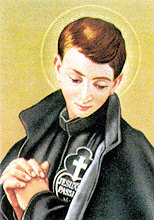
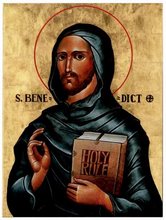
St. Benedict Joseph Labre

He set forward on his life's journey clad in an old coat, a rosary about his neck, another between his fingers, his arms folded over a crucifix which lay upon his breast. In a small wallet he carried a Testament, a breviary, which it was his wont to recite daily, a copy of the "Imitation of Christ", and some other pious books. Clothing other than that which covered his person he had none. He slept on the ground and for the most part in the open air. For food he was satisfied with a piece of bread or some herbs, frequently taken but once a day, and either provided by charity or gotten from some refuse heap. He never asked for alms and was anxious to give away to the poor whatever he received in excess of his scanty wants.

The first seven of the thirteen remaining years of his life were spent in pilgrimages to the more famous shrines of Europe. He visited in this way Loreto, Assisi, Naples, Bari, Fabriano in Italy; Einsiedeln in Switzerland; Compostella in Spain; Parav-le-Monial in France. The last six years he spent in Rome, leaving it only once a year to visit the Holy House of Loreto. His unremitting and ruthless self-denial, his unaffected humility, unhesitating obedience and perfect spirit of union with God in prayer disarmed suspicion not unnaturally aroused as to the genuineness of a Divine call to so extraordinary a way of existence. Literally worn out by his sufferings and austerities, on the 16th of April 1783, he sank down on the steps of the church of Santa Maria dei Monti in Rome and, utterly exhausted, was carried to a neighboring house where he died. His death was followed by a multitude of unequivocal miracles attributed to his intercession. The life written by his confessor, Marconi, an English version of which bears the date of 1785, witnesses to 136 miraculous cures as having been certified to up to 6 July, 1783. So remarkable, indeed, was the character of the evidence for some of the miracles that they are said to have had no inconsiderable part in finally determining the conversion of the celebrated American convert, Father John Thayer, of Boston who was in Rome at the time of the saint's death.

Benedict was proclaimed Venerable by Pius IX in 1859 and canonized by Leo XIII 8 December, 1881. His feast is kept on the 16th of April, the day of his death.

(source) The Catholic Encyclopedia, Volume II. Published 1907. New York: Robert Appleton Company. Nihil Obstat, 1907. Remy Lafort, S.T.D., Censor. Imprimatur. +John M. Farley, Archbishop of New York.

Tuesday, January 8, 2008

Self-annihilation II


After the heroic death of his uncle during an epidemic in September 1766, Benedict, who had dedicated himself during the scourge to the service of the sick and dying, returned to Amettes in November of the same year. His absorbing thought at this time was still to become a religious at La Trappe, and his parents fearing that further opposition would be resistance to the will of God fell in with his proposal to enter the cloister. It was suggested, how ever, by his maternal uncle, the Abbé Vincent, that application be made to the Carthusians at Val-Sainte-Aldegonde rather than to La Trappe. Benedict's petition at Val-Sainte-Aldegonde was unsuccessful but he was directed to another monastery of the same order at Neuville. There he was told that as he was not yet twenty there was no hurry, and that he must first learn plain-chant and logic. During the next two years he applied twice unsuccessfully to be received at La Trappe and was for six weeks as a postulant with the Carthusians at Neuville, he finally sought and obtained admission to the Cistercian Abbey of Sept-Fonts in November, 1769. After a short stay at Sept-Fonts during which his exactness in religious observance and humility endeared him to the whole community, his health gave way, and it was decided that his vocation lay elsewhere. In accordance with a resolve formed during his convalescence he then set out for Rome. From Chieri in Piedmont he wrote to his parents a letter which proved to be the last they would ever receive from him. In it he informed them of his design to enter some one of the many monasteries in Italy noted for their special rigor of life. A short time, however, after the letter was dispatched he seems to have had an internal illumination which set at rest forever any doubts he might have as to what his method of living was to be. He then understood "that it was God's will that like St. Alexis he should abandon his country, his parents, and whatever is flattering in the world to lead a new sort of life, a life most painful, most penitential, not in a wilderness nor in a cloister, but in the midst of the world, devoutly visiting as a pilgrim the famous places of Christian devotion". He repeatedly submitted this extraordinary inspiration to the judgment of experienced confessors and was told he might safely conform to it. Through the years that followed he never wavered in the conviction that this was the path appointed for him by God.

(Source) The Catholic Encyclopedia, Volume II. Published 1907. New York: Robert Appleton Company. Nihil Obstat, 1907. Remy Lafort, S.T.D., Censor. Imprimatur. +John M. Farley, Archbishop of New York.

More in next post! BTW, I don't post it all in one LONG post because I, myself do not read LONG posts on blogs so I figure many others do the same. My preference is smaller bites of information to be taken in over longer periods of time. Hope you don't mind this method. May Mary's prayers go with you always. Amen+

Monday, January 7, 2008

Self-annihilation I


Here starts a new series. I've been reading, that is...when I can pry it from my dear husband, a book on the subject of the interior life of souls. I'll post more on the book later. The part that spiked my interest especially was a portion on self annilhilation. First off, the term is very interesting, as I have a strong tendancy to be attracted to the radical side of Catholicism - I want it all, not just a little, not just a taste of Catholicism, I want the whole meal, dessert and all. Yep, that's me. In case you were wondering, I also fall far short of the ideals sainthood and interior perfection. In fact, the more I read holy books, the more I'm convinced that I have no virtue at all. Anyway - I found a saint I'd not heard of previously who is held up as THE model of self annilhilation. Here's his story...

St. Benedict Joseph Labre

Born: 26 March, 1748 at Amettes in the Diocese of Boulogne, France;

Died in Rome 16 April, 1783.

He was the eldest of fifteen children. His parents, Jean-Baptiste Labre and Anne-Barba Grandsire, belonged to the middle class and so were able to give to their numerous offspring considerable opportunities in the way of education. His early training he received in his native village in a school conducted by the vicar of the parish. The account of this period furnished in the life written by his confessor, Marconi, and that contained in the one compiled from the official processes of his beatification are at one in emphasizing the fact that he exhibited a seriousness of thought and demeanor far beyond his years. Even at that tender age he had begun to show a marked predilection for the spirit of mortification, with an aversion for the ordinary childish amusements, and he seems from the very dawning of reason to have had the liveliest horror for even the smallest sin. All this we are told was coexistent with a frank and open demeanor and a fund of cheerfulness which remained unabated to the end of his life.
At the age of twelve his education was taken over by his paternal uncle, François-Joseph Labre, curé of Erin, with whom he then went to live. During the six following years which he spent under his uncle's roof, he made considerable progress in the study of Latin, history, etc. but found himself unable to conquer a constantly growing distaste for any form of knowledge which did not make directly for union with God. A love of solitude, a generous employment of austerities and devotedness to his religious exercises were discernible as distinguishing features of his life at this time and constitute an intelligible prelude to his subsequent career.
At the age of sixteen he resolved to embrace a religious life as a Trappist, but having on the advice of his uncle returned to Amettes to submit his design to his parents for their approval he was unable to win their consent. He therefore resumed his sojourn in the rectory at Erin, redoubling his penances and exercises of piety and in every way striving to make ready for the life of complete self-annihilation to which the voice within his soul seemed to be calling him.
The Catholic Encyclopedia, Volume II. Published 1907. New York: Robert Appleton Company. Nihil Obstat, 1907. Remy Lafort, S.T.D., Censor. Imprimatur. +John M. Farley, Archbishop of New York
More in next post!