Showing posts with label Purgatory meditation. Show all posts

Saturday, October 23, 2010

Holy Card

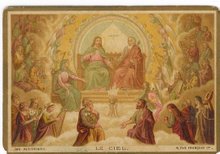
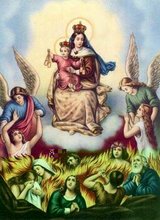
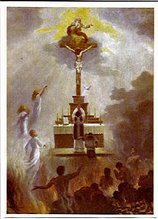
Image of a French Holy card published by R. Pannier, Paris, in the late 19th century
They don't make them like this anymore. This is an old, 1800's holy card that I ran across when searching for an image for my previous post on a prayer for the dying - putting into google "holy card dying" This is a poignant meditation on death. This is a topic close to me at present as I spent the better part of the last day assisting at the bedside of a dying family member. Below is the interpretation of the words on the card from French.
“Eternity. You, mortal, who has an immortal soul, study, meditate, ponder over this great word: ETERNITY.” Frame: “Do the good while there is time. Ponder over Death to live well and to die well. Think about death, give up sin, stay out of the world, give yourself up to God. Death is certain, only its hour is uncertain.” Inside the frame: “Prepare for a good death through a good life, for time is short. Today is my turn, tomorrow yours. I have been, you shall be what I am. Pray for the souls in Purgatory. They expect your prayers and the relief of their plight. Make a choice. Eternal Heaven. Eternal Hell.”

Friday, June 26, 2009

Living Purgatory


"Blessed are those who are persecuted for righteousness’ sake, for theirs is the kingdom of heaven. Blessed are you when men revile you and persecute you and utter all kinds of evil against you falsely on my account. Rejoice and be glad, for your reward is great in heaven" (Matt 5:10-12)

Those who are seriously trying to live out the gospel and will not capitulate to the spirit of the world have every reason to expect persecution. It would be expected to meet with persecution from neighbors, co-workers, even family, but the place we would least expect this would be within our very own parishes. This is a most painful affliction indeed.

For where does one turn when their "heaven on earth" has become a living purgatory....or worse. Drive to another parish - 50, 100 or 150 miles? Stay and close your eyes tightly to the "innovations" thrust upon your weary soul? How does one close their ears? What of the scandal given to children? Stay and suffer with the Hidden Jesus? Change parishes? Stay? Go? Just because it valid does that mean we can do NOTHING that is beautiful? Nothing that is reverent?

O Lord, You once told Peter that one day he would be led where he did not want to go. Do Thou shepherd me Lord and save my ears and my eyes from all that offends Thee. Amen+

Tuesday, November 11, 2008

Indulgences for Dummies

(photo credit to Micki at Holy Cards for your Inspiration)
From the German: "Eternal rest grant unto them, may eternal light shine upon them. May they rest in peace!"
The following is a summary from the Handbook of Indulgences available here for purchase. No Catholic home should be without it!
Who Needs Indulgences?: Anyone with unforgiven venial (less serious) sin or temporal punishment remaining from sins forgiven in life. This applies to the living and the souls suffering in purgatory. In reality, most souls go to purgatory before entering heaven.

What are Indulgences?: An indulgence is a remission of time in purgatory drawn form the 'spiritual treasury' of Jesus, Mary and the Saints who earned graces which they did not need. The Roman Catholic Church, the True Church, unlocks these graces through its authority to 'bind and loose' (Matthew 16:19). They may be applied by a person to himself/herself or offered to a soul (or the souls) suffering in purgatory.

How are Indulgences Gained?:

1. The person must be baptized and free from mortal sin (in the state of grace).

2. The person must have the intention (desire or goal) of obtaining the indulgence (they are not gained accidentally).

3. The work/works prescribed by the Church must be completely and correctly performed.

What is a Partial Indulgence?: A partial indulgence remits a part of the temporal punishment due. There is no limit to the number of partial indulgences that can be obtained in a single day.

What is a Plenary Indulgence?: A plenary indulgence remit all of the temporal punishment due leaving the soul completely clean. This would allow a soul to escape purgatory and enter heaven.

How is a Plenary Indulgence Obtained?:
1. The prescribed work must be performed.

2. In addition to the normal conditions, the person gaining the indulgence must be completely free from all all attachment to sin, including venial sin.

3. The person gaining gaining the indulgence must go to sacramental confession at least 20 days before or after the day that the work is performed.

4. The person gaining the indulgence must receive communion and pray for the intentions of the Pope (at least one Our Father and Hail Mary) specifically for each plenary indulgence desired.

5. The Church lengthened the time for confession, communion and prayer for the Pope to 20 days before or after the day of the indulgence (January 29, 2000: Gift of Indulgence document).

6. Only one plenary indulgence can be obtained a day (the only exception being that a second may be obtained at the moment of death).

What are Some of the Works Meriting the Plenary Indulgence?: Refer to the Handbook of Indulgences for additional places and times of the year which plenary indulgences may be obtained. The works below are referenced with the Handbook's listing number.

1. Way/Stations of the Cross in a Church by moving from station to station while meditating at each one.

2. Rosary: five decades said with others (family, parish members, religious community).

3. Reading Sacred Scripture for at least 30 minutes.

4. Adoration of the Blessed Sacrament for at least 30 minutes.

5. Visiting a Church or Oratory on All Souls Day with recitation of one Our Father and the Creed.

6. Hearing a Papal Blessing via radio/television when given to Rome and the world. Must be live.

7. Moment of Death: if a priest is unavailable, a person in the state of grace may obtain a plenary indulgence providinga. They have been (a.) in the habit of reciting some prayers during their lifetime (which substitutes for the required confession/communion/prayers for the Pope)and (b.) They are properly disposed (free from attachment to sin, including venial sin).

What are the Works Which Earn a Partial Indulgence?

1. Prayers and pious invocations.

2. Visit to a cemetery and praying for the dead (plenary from Nov. 1-8 with usual conditions).

3. Performing in the spirit of faith adn mercy a corporal or spiritual Work of Mercy (including almsgiving) to serve someone in need. (Second General Grant)

4. Mortification/penance: voluntarily depriving oneself of what is licit/allowed and pleasing to them. (Third General Grant).

5. Works meriting a plenary indulgence may also be performed for a partial indulgence.

How Can I Gain Every Indulgence Possible?: A key aspect of indulgences is having the intention of gaining the indulgence: they are not gained accidentally or automatically. An easy way to avoid loosing indulgences is making a simple prayer at the beginning of the day asking to gain all indulgences earned. Here is an example:

"I desire to gain each indulgence I earn through prayer and work today. Amen.+"

Monday, November 10, 2008

What are Indulgences?


From New St. Joseph Baltimore Catechism (Nihil Obstat; Imprimatur; 1962)

435. What is an indulgence? An indulgence is the remission granted by the Church of the temporal punishment due to sins already forgiven.

436. How many kinds of indulgences are there? There are two kinds of indulgences, plenary and partial.

437. What is a plenary indulgence? A plenary indulgence is the remission of all the temporal punishment due to our sins.

438. What is a partial indulgence? A partial indulgence is the remission of part of the temporal punishment due to our sins.

439. How does the Church by means of indulgences remit the temporal punishment due to sin? The Church by means of indulgences remits the temporal punishment due to sin by applying to us from her spiritual treasury part of the infinite satisfaction of Jesus Christ and of the superabundant satisfaction of the Blessed Virgin Mary and of the saints.

440. What is the superabundant satisfaction of the Blessed Virgin Mary and of the saints? The superabundant satisfaction of the Blessed Virgin Mary and of the saints is that which they gained during their lifetime but did not need, and which the Church applies to their fellow members of the communion of saints.

441. What must we do to gain an indulgence for ourselves? To gain an indulgence for ourselves we must be in the state of grace, have at least a general intention of gaining the indulgence, and perform the works required by the Church.

442. Can we gain indulgences for others? We cannot gain indulgences for other living persons, but we can gain them for the souls in purgatory, since the Church makes most indulgences applicable to them.

Friday, November 7, 2008

How to Help the Holy Souls


To him therefore who knoweth to do good, and doth it not, to him it is sin (James 4:17)

There are a variety of ways to help the Holy Souls. Some of which are listed in a previous post, others are below. Keep in mind virtually everthing and anything can be offered to God as an act of love and charity for them. "Lord, may each movement of my hand today be for your glory and for the assistance of your faithful departed. Amen+" Practiced regularly, you will be shocked at what your little prayers and offerings have merited you at your particular judgement!

"The Holy Sacrifice is the greatest help we can offer, because its effect depends on itself, and not on the piety of the priest who offers it...If we cannot have a Mass said, we should at least hear Mass for our dear departed. A Mass has infinite merit..." (My Catholic Faith; 1949-1954)

In addition to the Requiem Mass following death, a Mass for the departed may be arranged for just about any day of the year. The following are days of traditional significance for Masses for the Departed:

1. All Souls Day

2. Third day/year following burial (Christ's time in the tomb); Seventh day/year (symbolic of eternal repose; St. Ambrose) and 30th day/year (St. Ambrose) from death or burial.

3. Yearly anniversary day from death or burial

4. Gregorian Masses: 30 consecutive Masses following the repose (burial) popularized by 6th Century Pope St. Gregory the Great. This could also be ANY 30 days following the death of a person because God hears all prayers outside of time.

5. Purgatorian Society Masses: daily masses said for souls those enrolled.

Thursday, November 6, 2008

What Does it Mean to Pray for the Poor Souls?


It means everything that we can offer for the faithful departed.

~We can offer our bodily pains in expiation for their sins.
~We can offer our spiritual sufferings, our disappointments and fears, our discouragement and estrangement from those we love.
~We can offer our vocal prayers, like the Rosary, the Memorare, the Angelus, the recitation of the Divine Office.
~We can offer our mental prayers, like the Way of the Cross, our daily meditation and examination of conscience.
~We can offer our mortifications, like giving up some delicacy at table, or performance of some unpleasant work.

But the most effective offering we can make for the Poor Souls is the Holy Eucharist at the Sacrifice of the Mass, Holy Communion and adoration of the Blessed Sacrament. Over the centuries, the Catholic faithful have by now offered countless Masses for the Poor Souls. In the Society of Jesus, we priests are expected to offer one Mass each month for all the deceased Jesuits. This amounts to over sixteen thousand Masses that are to be said every month for the members of the Society of Jesus who are still in purgatory.

May I offer a recommendation? During the month of November, I suggest that we make a list of all the deceased persons whom we wish to specially remember in our Masses, prayers and sacrifices for the repose of their souls. Add to this list as those enter eternity whom you wish to specially commend to the mercy of God. This, by the way, is called a Necrology. Every Catholic diocese in the world has a Necrology of its deceased priests. Every family should have its own Necrology of deceased members whom we daily remember to our merciful Lord.

Every time you say the grace after meals, be sure to add the invocation, "May the souls of the faithful departed, through the mercy of God, rest in peace. Amen." In every Rosary you recite, do not forget to say after each decade, " O, my Jesus, forgive us our sins, save us from the fires of hell, and bring all souls to heaven, especially those who are in most need of thy mercy."
Remember that devotion to the Poor Souls is really a covenant between them and us. We pray and sacrifice for them, They can pray and suffer for us. They appreciate whatever help we give them, to lessen their suffering and to shorten their stay in Purgatory. They will continue to show their appreciation when we join them in a heavenly eternity.

(From a homily by Fr. John A. Hardon, S.J. accessed here)

Tuesday, November 4, 2008

The Two Sides of Purgatory


It must seem strange to speak of devotion to the Poor Souls. But it is not really strange. Devotion to the Poor Souls has two sides: our side and the side of the souls in purgatory.
On their side, the Poor Souls are united with us in the one Kingdom of Christ. They can pray and obtain blessings for us here on earth. They are united, as the Second Vatican Council teaches, with the pilgrim Church in the Communion of Saints. We are therefore encouraged to invoke their aid, with a confidence of being heard by those who understand our needs. They know from their own experience what it means to carry the cross here on earth.

On our side we are to do everything we can to help the Poor Souls in the Church Suffering. The sufferings in purgatory are not the same for all. They depend on each person's degree of sinfulness. St. Thomas Aquinas held that the least pain in purgatory is greater than the worst pain in this life. St. Bonaventure held that the worst suffering after death was greater than the worst suffering on earth, but the same could not be said regarding the least pain in purgatory. In general, however, we should say that the pains of purgatory are greater than those on earth.

Monday, November 3, 2008

Why are Souls in Purgatory?


In order to understand why the Poor Souls are in purgatory, as Catholics we should know what we believe about the double effect of every sin. Every time we sin we lose more or less of God's grace. This we call "guilt." Every time we sin we also incur a debt of pain. This we call "penalty."
Mortal sins are called mortal because they deprive the sinner of sanctifying grace and the right to heaven. Mortal sins also incur the debt of eternal punishment.

When mortal sins are forgiven in the sacrament of penance, sanctifying grace is restored and the debt of eternal punishment is removed. But normally there is still temporal punishment to be expiated. Moreover, venial sins always carry with them a debt of temporal punishment, which is more or less remitted, depending on a person's spiritual dispositions.

This immediately tells us that because we are sinners we must expect to suffer in expiation for our sins. The choice we have is between patiently suffering here on earth or suffering in purgatory after our bodily death.

November if the Month of the Holy Souls


Who Are the Poor Souls?

The Poor Souls are the souls of those people who died in the friendship of God. But they still have some suffering to undergo for the sins they had committed during their lives on earth. It is the infallible teaching of the Catholic Church that there is a purgatory. As the word itself indicates, purgatory is the state of those who still have to be cleansed of the penalty which they owe for their past offenses against God.

The Poor Souls are poor because they are in suffering and need our help. We know from Sacred Scripture that there is a purgatory, as described in the second book of Maccabees, which unfortunately has been removed from the Protestant Old Testament. As described in Sacred Scripture, Judas Maccabeus, the leader of a Jewish army, decided to offer a sacrifice for the Jews who had died in battle. The Bible then tells us,"If he had not expected the fallen to rise again, it would have been superstitious and foolish to pray for the dead." However, since he believed in the resurrection of the dead, "he had this atonement sacrifice offered for the dead, so that they might be released from their sins" (II Maccabees 12:41?45).

The existence of purgatory is a defined truth of the Catholic faith. Those who die without the guilt of mortal sin, but with temporal punishment still due for their past offenses "are cleansed after death in purgatorial or cleansing punishments."

It is commonly believed that the principal suffering in purgatory is the pain of loss. The souls are temporarily deprived of the Beatific Vision.

Thursday, July 10, 2008

How to Avoid Purgatory


Twelve steps to be used to avoid going to purgatory after death. These are also spiritual practices that will not fail to bring you to the heights of holiness.

12 Steps to Avoid Purgatory
1. In every prayer you say, every Mass you hear, every Communion you receive, every good work you perform have the express intention of imploring God to grant you a holy and happy death and no Purgatory. Surely God will hear a prayer said with such confidence and perseverance.

2. Always wish to do God’s will. It is in every sense the best for you. When you do or seek anything that is not God’s will, you are sure to suffer. Say, therefore, fervently each time you recite the Our Father: Thy will be done.

3. Accept all the sufferings, sorrows, pains and disappointments of life, be they great or small, ill health, loss of goods, the death of your dear ones, heat or cold, rain or sunshine as coming from God. Bear them calmly and patiently for love of Him and in penance for your sins. Of course, one may use all his efforts to ward off trouble and pain, but when one cannot avoid it let him bear it patiently. Impatience and revolt make sufferings vastly greater and more difficult to bear.

4. The greatest act in Christ’s life was His Passion. As He had a Passion so each one of us has a Passion. Our Passion consists in the sufferings and labors of every day. Therefore, let us do our work, accept its disappointments and hardships and bear our pains in union with the Passion of Christ. We gain more merit by a little pain than by years of pleasure.

5. Forgive all injuries and offences for in proportion, as we forgive others, God forgives us. Go to confession. This sacrament does more than “just” rid us of our sins; it gives us a tremendous increase in sanctifying grace. It wins for us a higher place in Heaven, with increased union with God. Each time we go to confession, we are preserved from many dangers and misfortunes which might otherwise have befallen us. A devout confession helps us to hear the inspirations of the Holy Spirit, and to hear and follow the advice of our guardian angels.

6. Avoid mortal sins, deliberate venial sins and break off bad habits. Then it will be relatively easy to satisfy God’s justice for sins of frailty. Above all avoid sins against charity and chastity in thought, word and deed for these sins are the reason why many souls are detained in Purgatory for a long time.

7. If afraid of doing too much work, do many little things, acts of kindness and charity, give the alms you can, don’t grumble or complain when things are not as you please, don’t complain of others, never refuse to do a favor for others when possible. These and such acts are a splendid penance.

8. Do all in your power for the Holy Souls in Purgatory. Pray for them constantly, get others to do so, join the Friends of the Poor Souls and ask all those you know to do likewise. The Holy Souls will repay you most generously.

9. There is no more powerful way of obtaining from God a most holy and happy death than by weekly confession, daily Mass and daily communion. Masses may be arranged after or before someone’s death to expedite their time in Purgatory.

10. A daily visit to the Blessed Sacrament – if only for three or four minutes – is an easy way of obtaining the same grace. Kneel in the presence of Jesus with eyes fixed on the Tabernacle or Monstrance, sure that He is looking at you, then repeat little prayers like these: My Jesus, Mercy. My Jesus, have pity on me a sinner. My Jesus, I love you. My Jesus, give me a happy death.

11. Enroll in and wear the Brown Scapular of Our Lady of Mount Carmel. “Whosoever dies clothed in this scapular shall not suffer eternal fire.” This is the Blessed Virgin Mary’s Promise, made July 16, 1251 to St. Simon Stock. The Sabbatine Privilege is Mary’s promise to release from Purgatory soon after death all those who: 1) wear the brown scapular 2) observe chastity according to their state in life and 3) say the Little Office of the Blessed Virgin Mary every day. To be eligible for this scapular promise, one must be enrolled in the Family of Carmel. This is a simple ceremony which takes only a moment and may be done by any Carmelite or duly authorized priest. Mary’s motherhood is not limited to Catholics. It is extended to all men. Many miracles of conversion have been wrought in favor of non-Catholics who have practiced the scapular devotion.

12. Use holy water. Holy water is a sacramental that remits venial sin. Because of the blessing attached to it, Holy Church strongly encourages its use upon her children especially when danger threatens such as fire, storms, sickness and other calamities. Every Catholic home should have a supply of holy water. Keep your soul beautifully pure in God’s sight by making the Sign of the Cross carefully while saying: “By this holy water and by Thy Precious Blood, wash away all my sins and the sins of the Poor Souls in Purgatory, O Lord”.

I would add one more sure way to avoid purgatory yourself ~ after prayerful discernment, take this vow:
Heroic Act of Charity
O Holy and Adorable Trinity, desiring to aid in the relief and release of the Holy Souls in Purgatory, through my devotion to the Blessed Virgin Mary, I cede and renounce, on behalf of these souls, all the satisfactory part of my works, and all the suffrages which may be given to me after my death. In their entirety, I offer them to Mary, the Most Holy Mother of God, that she may use them, according to her good pleasure, for those souls of the faithful departed whom she desires to alleviate their suffering. O my God, deign to accept and bless my offering which I make to Thee through the most august Queen of Heaven and Earth. Amen.
Learn more here.
I would also suggest taking an additional vow of non-revocation to the above - show God you are really serious and also prevent the loss of so much merit in your dying frailty.

Friday, April 4, 2008

The Pains of Purgatory


St. Thomas describing the pains of purgatory says:

With regard to the least pain of Purgatory it surpasses the greatest pain of this life. For the more a thing is desired the more painful is its absence. And since after this life the holy souls desire the Sovereign Good, . . . it follows that they grieve exceedingly for their delay

(Source: Supp. Appendix 1, 2, 1).
Please don't forget to pray for them. They rely on our prayers completely and are unable to remind us!

Sunday, February 17, 2008

Reminder...

Don't forget in this Lenten season, as we try to "pay down" some of our debts due to sin - so also assist the Holy Souls in Purgatory. We are to offer alms, as we all know almsgiving "covereth a multitude of sins" Who is more poor than they? In praying, offering masses, doing the stations of the Cross for the members of the Church suffering - we in fact do all the corporal and spiritual works of mercy at once. We visit those in prison, give water and food to the thirsy and hungry, clothe the naked and so on...

Thursday, October 18, 2007

How to Shorten Your Own Purgatory

by Paolo Veronese 1580
"Allegory of Vice and Virtue, The Choice of Hercules"

(photo credit)

In the end Jesus will triumph over all temptation. Put in simplest terms, growing in virtue will better prepare the soul for eternity. The way I like to think of it, the more virtue the less purgatory I can hope for! Not to mention the universal need to be closer to God, who is Perfect Virtue. We all have vices. We have the duty to combat them with the opposite virtue. Have a problem with pride? Pray and offer sacrifices for humility! I came across this handy chart on Jeff Cavin's blog:

"Combat the vices in your life by praying for and developing virtue. The list below will help you as a guide:"
VICE -----VIRTUE
1.Pride---- Humility
2.Avarice-- Generosity
3.Envy-----Charity
4.Wrath ---Meekness
5.Lust----- Chastity
6.Gluttony- Temperance
7.Sloth----- Diligence

What we cannot DO for ourselves, we can PRAY for. I cannot battle myself the vices that my soul are enslaved to. I am a poor, weak sinner. What I CAN do is PRAY for the opposite virute and commend to God what I myself am incapable of. Amen+

Thursday, August 30, 2007

Right Teaching About Purgatory and How to Avoid Going There


From the Good 'ol Baltimore Catechism no. 3, Lesson 14:

184. Who are punished in purgatory?
Those are punished for a time in purgatory who die in the state of grace but are guilty of venial sin, or have not fully satisfied for the temporal punishment due to their sins.
(a) There will be no purgatory after the general judgment.
(b) Since we do not know how long individual souls are detained in purgatory, there is need for persevering prayer for the repose of the souls of all those who die after reaching the use of reason, except those who are canonized or beatified by the Church.
(c) The souls in purgatory are certain of entering heaven as soon as God's justice has been fully satisfied.

How to Avoid Purgatory by Fr. Paul O'Sullivan

1. In every prayer you say, every Mass you hear, every Communion you receive, every good work you perform, have the express intention of imploring God to grant you a holy and happy death and no Purgatory. Surely God will hear a prayer said with such confidence and perseverance.
2. Always wish to do God's will. It is in every sense the best for you. When you do or seek anything that is not God's will, you are sure to suffer. Say fervently, therefore, each time you recite the Our Father: "Thy will be done"
3. Accept all the sufferings, sorrows, pains and disappointments of life, be they great or small: ill health, loss of goods, the death of your dear ones, heat or cold, rain or sunshine, as coming from God. Bear them calmly and patiently for love of Him and in penance for your sins. Of course one may use all his efforts to ward off trouble and pain, but when one cannot avoid them let him bear them manfully. Impatience and revolt make sufferings vastly greater and more difficult to bear.
4. Christ's life and actions are so many lessons for us to imitate. The greatest act in His life was His Passion. As He had a Passion, so each one of us has a passion. Our passion consists in the sufferings and labours of every day. The penance God imposed on man for sin was to gain his bread in the sweat of his brow. Therefore, let us do our work, accept its disappointments and hardships, and bear our pains in union with the Passion of Christ. We gain more merit by a little pain than by years of pleasure.
5. Forgive all injuries and offences, for in proportion as we forgive others, God forgives us.
6. Avoid mortal sins and deliberate venial sins and break off all bad habits. Then it will be relatively easy to satisfy God's justice for sins of frailty. Above all, avoid sins against charity and against chastity, whether in thought, word or deed, for these sins [and the expiation for them] are the reason why many souls are detained in Purgatory for long years.
7. If afraid of doing much, do many little things, acts of kindness and charity, give the alms you can, cultivate regularity of life, method in work, and punctuality in the performance of duty; don't grumble or complain when things are not as you please; don't censure and complain of others; never refuse to do a favour to others when it is possible. These and suchlike little acts are a splendid penance.
8. Do all in your power for the Holy Souls in Purgatory. Pray for them constantly, get others to do so . . . and ask all those you know to do likewise. The Holy Souls will repay you most generously.
9. There is no way more powerful of obtaining from God a most holy and happy death than by weekly Confession, daily Mass and daily Communion.
10. A daily visit to the Blessed Sacrament--it need only be three or four minutes--is an easy way of obtaining the same grace. Kneeling in the presence of Jesus with eyes fixed on the Tabernacle, sure that He is looking at us, let us for a few minutes repeat some little prayer like these: "My Jesus, mercy." "My Jesus, have pity on me, a sinner" "My Jesus, I love You" "My Jesus, give me a happy death"

Wednesday, April 11, 2007

Meditations on Purgatory III


The Seriousness of Scandal Cont.


We pick up today right where we left off with yesterday's post, quoting St. Peter Canisius in St. Alphonsus de Ligouri's "The Glories of Mary"


"One night, a certain devout canon named Frederick was praying in the church of St. Maurice and begging the Lord to remove the scandal of this prelate from the diocese. Suddenly, the door was opened by a strong blast of wind. Two young men entered carrying torches in their hands and took up positions on either side of the high altar. These two were followed by two others who laid a carpet before the altar and put two golden chairs on it. Then came another youth in the uniform of a soldier, a sword in his hand. The soldier stopped in the center of the church and shouted aloud: "O you saints of heaven, whose relics are here in this church, come and be present at the great act of justice which the Supreme Judge is about to perform." At this, many saints appeared, along with the twelve Apostles who were to be assistant judges in the trial. Finally, Jesus Christ entered and sat down on one of the two chairs. Next, Mary entered with a retinue of holy virgins and sat down on the chair beside her son. Eventually, the court was called to order and the criminal bidden to appear. The criminal, of course, was none other than the unfortunate Otto."


"In the name of the people who had been scandalized, Saint Maurice demanded justice because of the evil life of the bishop. All cried out and said: "Lord, he deserves death!" The Eternal Judge answered: "Let him die!" Mary's merciful heart was filled with grief. Before the death sentence was carried out, she left the church so that she would not have to witness this terrible act of justice. Only then did the heavenly minister of justice, the one with the sword in his hand, approach Otto. With one stroke he lopped off his head. Then the vision diappeared."


"The church was left in darkness. Trembling, the canon went to light a lamp at the lower end of the church. When he came back to his place, he saw Otto's beheaded corpse and the floor of the church all stained with blood. Morning came and the people all began to flock into the church. The canon told them what he had seen and what had actually happened. The same day, the unfortunate Otto, now condemned to hell, appeared to one of his chaplains who was unaware as yet of what had taken place in the church. Otto's corpse was thrown into a swamp. The blood spots on the floor remained there as a perpetual reminder of the event, though they were always covered by a carpet. Ever since that day, it has been the custom to uncover them whenever a new bishop takes possession of the see, so that he may be moved by the sight to order his life properly and not be ungrateful to the Lord and his most holy mother for their graces."


Perhaps I should have labelled this a meditation on hell. This true story has always given me chills. The Lord is merciful and kind, slow to anger....note that, SLOW to anger does not mean never to anger. We trust in God's mercy, but we must balance this with fear of God's just judgement. Let us strive to keep these two in balance.


I attempted to do some research on this story. I was able to find the church in which this event took place, The Church of Saint Maurice, which is now the Cathedral of Magdeburg, dedicated to both St. Maurice and St. Catherine of Alexandria. It is recorded in history that Emperor Otto I founded this Cathedral and personally received the body of St. Maurice and the relics of many saints (this is not the Otto of this story). Otto I's tomb can be visited within this beautiful gothic cathedral. I also could find a record of a bishop Otto von Hessen but I have no idea if this is the same one. Otto apparently was a very common name. This book also does not relate any dates as to this occurance, but we ought to trust the words of the saints. We are to take heed of it.


Prayer

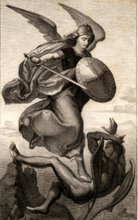
Saint Michael the Archangel, defend us in battle. Be our defense against the wickedness and snares of the devil. May God rebuke him we humbly pray. And do thou, O Prince of the Heavenly Host, by the power of God, cast into hell satan, and all the evil spirits who prowl about the world, seeking the ruin of souls. Amen+


Tuesday, April 10, 2007

Meditations on Purgatory II


Story from St Peter Canisius - Part I
Feastday: December 21
b: 1521 d: 1597
This is a story which is related by this great Jesuit priest, theologian, writer and Doctor of the Church. He lived during the time of the reformation and ministered to the heavily persecuted Catholics in rebellious Protestant Germany. Read more about St. Peter Canisius here. Its a somewhat lengthy story, but is a riveting read, therefore it is here presented in two parts.
First off ~ this is a true story, related to us via St. Alphonsus de Ligouri in his famous book "The Glories of Mary" available for purchase here. As you may know, St. Alphonsus is also a Doctor of the Church and his book of course bears the Church's Imprimatur. This book has only been outsold by the Holy Bible in the world since its first printing in 1750 - it is indeed one of the greatest spiritual classics of all time.
Our topic, of course, is again - giving scandal, and the tragic outcome of doing so. Scandal is a horrible sin, but sadly one many, if not most of us are guilty of at some time in our lives. We must pray for the conversion of those who give scandal, pray in reparation for any purposeful or inadvertant scandal which we have given. The choice is ours to pay the debts due to this sin in this life through pentitential reparation, or in the next life in purgatory. This story is offered as a meditation, albeit a TRUE story which demonstrates very clearly the dire consequences of scandal given.
"Trithemius, St. Peter Canisius, and others relate that in Magdeburg, a city in Saxony, there was a young man named Otto who as a youth was so simple-minded that he was the laughingstock of his fellow students. One day when he was more than usually disturbed over his backwardness, he knelt before a statue of the Blessed Virgin and prayed to her. A short time later, Mary appeared to him in a dream and said: "Otto, I come to reassure you, for I shall obtain from God such talents that the others will not only stop taunting you but will even admire you. Moreover, I promise that after the bishop's death, you will be chosen to succeed him." Everything Mary told him came true. He made progress in his studies and eventually became bishop of that city.
But Otto was so ungrateful to God and to Mary, his benefactress, that he gave up all semblance of devotion and became a scandal to everybody. One night while he was lying in a bed of sin, he heard a voice saying to him: "Otto, stop this at once; you have gambled enough with your soul's salvation." When he first heard these words he became angry, thinking that someone was whispering to him in order to scold and correct him. But when he heard the same words repeated the second and third night, he began to be afraid that it was a voice from heaven. Nevertheless, he went on with his sinful way of life. When the three months which God had given him to amend had elapsed, the punishment came. And this is what it was....
Come back tomorrow for this stories' conclusion!
Prayer
O holy and heavenly child, destined Mother of my Redeemer and great mediatrix of miserable sinners, have pity on me. Behold at your feet another ungrateful soul who appeals to you and asks for mercy. Is it true that because of my ingratitude to God and to you, I deserve that God and you should abandon me; but I have heard, and I believe it to be so (knowing the greatness of your mercy), that you do not refuse to help anyone who recommends himself to you with confidence. Therefore, O most exalted Lady, since there is no one but God above you, and the greatest saints in heaven are small compared with you, O saint of saints, O Mary, abyss of charity and full of grace, help me, a senseless sinner, who has lost grace through his own fault.
Amen+

Monday, April 9, 2007

Meditations on Purgatory


Let us Consider the Causes of Lengthy Sufferings in Purgatory - Scandal
(Source: Purgatory by F.X. Schouppe by TAN Books)
A terrible expiation of suffering sadly awaits those of us who have given scandal to others in this life. To give scandal is to, through our example or words cause someone/s of weaker conscience to sin. If we lead a person thus into venial sin, we have sinned venially, if mortal sin ensues, then we have indeed sinned mortally.
Of course Our Lord spoke very severely of scandal: "Woe to the world because of scandals! Woe to that man by whom the scandal cometh! (Matthew 18:7)
"A painter of great skill and otherwise exemplary life had once made a painting not at all conformable to the strict rules of Christian modesty. It was one of those paintings which, under the pretext of being works of art, are found in the best families, and the sight of which causes the loss of so many souls.
True art is an inspiration from Heaven, which elevates the soul to God; profane art, which appeals to the senses only, which presents to the eye nothing but the beauties of flesh and blood, is but an inspiration of the evil spirit; his works, brilliant though they may be, are not works of art, and the name is falsely attributed to them. They are the infamous productions of a corrupt imagination.
The artist of whom we speak had allowed himself to be misled in this point by bad example. Soon, however, renouncing this pernicious style, he confined himself to the production of religious pictures, or at least of those which were perfectly irreproachable. Finally, he was painting a large picture in a convent of the discalced Carmelites, during which he was attacked by a mortal malady. Feeling he was about to die, he asked the Prior to allow him to be interred in the church of the monastery, and bequeathed to the community his earnings, which amounted to a considerable sum of money, charging them to have Masses said for the repose of his soul. He died in pious sentiments, and a few days passed, when a Religious who had stayed in the choir after Matins saw him appear in the midst of flames and sighing pitiously.
"What!" Said the Religious, "have you to endure such pain, after leading so good a life and dying so holy a death?" "Alas!" relied he, "it is on account of the immodest picture that I painted some years ago. When I appeared before the tribunal of the Sovereign Judge, a crowd of accusers came to give evidence against me. They declared that they had been excited to improper thoughts and evil desires by a picture, the work of my hand. In consequence of those bad thoughts some were in Purgatory, others in Hell. The latter cried for vengeance, saying that, having been the cause of their eternal perdition, I deserved, at least, the same punishment. Then the Blessed Virgin and the saints whom I had glorified by my pictures took up my defence. They represented to the Judge that that unfortunate painting had been the work of youth, and of which I had repented; that I had repaired it afterwards by religious objects which had been a source of edification to souls."
"In consideration of these and other reasons, the Sovereign Judge declared that, on account of my repentance and my good works, I should be exempt from damnation; but at the same time, He condemned me to these flames until that picture should be burned, so that it could no longer scandalize anyone." Then the poor sufferer implored the Religious to take messages to have the painting destroyed. "I beg of you, go in my name to such a person, proprieter of the picture; tell him in what condition I am for having yielded to his entreaties to paint it, and conjure him to make a sacrifice of it. If he refuses, woe to him! To prove that this is not an illusion, and to punish him for his own fault, tell him that before long he will lose his two children. Should he refuse to obey Him who has created us both, he will pay for it by a premature death."
"The religious delayed not to do what the poor soul asked of him, and went to the owner of the picture. The latter, on hearing these things, seized the painting and cast it into the fire. Nevertheless, according to the words of the deceased, he lost his two children in less than a month. The remainder of his days he passed in penance, for having ordered and kept that immodest picture in his house."
If such consequences occur due to one improper painting, what of millions of scandalous, impure or pornographic books sold in the U.S alone? What of the influence of impurity in movies, TV shows, video games and the like? What of the mere influence of our actions on the actions of others? Let us pray, pray that we do not cause scandal, confess our sins with sadness and amend our lives. Let us have Mary, Jesus and the saints as our examples instead of scandalous celebrities. Pray for the holy souls in purgatory as they suffer more than we can imagine!
Prayer
Graciously hear, O God, the fervent prayers we offer Thee for the suffering souls in purgatory, who, not having satisfied Thy justice, confide in Thine infinite mercy and our intercessions. Extend unto them Thy consolations, and redeem them, through Christ our Lord. Amen+
Eternal rest grant unto them, O Lord, and let perpetual light shine upon them. May they rest in peace. Amen+