Showing posts with label Pontmain. Show all posts

Friday, December 7, 2007

Our Lady of Hope - Part V


This comes from the official website for the Sactuary of Our Lady of Hope situated at the apparition site in Pontmain France. We ought to meditate and think on the meaning of Mary's appearance. She who is the Mother of Our Lord and Savior does not appear for just any reason. Whenever heaven sends her and she appears, there is significance for us all.

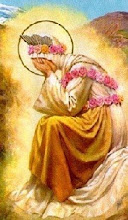
"The Virgin Mary did not speak at Pontmain. How should we interpret this apparition, the different expressions of the Virgin Mary and the message which unfurled at her feet ? Of course the revelations add nothing to the revelations of Christ, which are complete in themselves. They were not meant to teach us anything new, but rather to awaken our sleeping consciences.The Virgin Mary appeared at Pontmain to help us to understand Christ. Her message is centred on Christ. The first part of the message, “But pray my children” echoes Christ’s urgent exhortations to pray unceasingly, following the example of the Virgin Mary, of the centurion Corneille or the numerous blind or paralysed people we find in the Gospel. Jesus asks us to pray with insistence, faith and humility to fulfil God’s will and not our own.The next part of the message, “God will answer you very soon” is the continuation of this message. It reminds us that all prayers are sent to God, and God alone, who gives us everything. It also tells us that prayer is effective : Jesus repeated this message forcefully. The end of the message, “My son lets his heart be touched” is a reminder of Christ’s part in the divine plan. Mary shows Christ in all his humanity, by which “he should become in this way completely like his brothers” (Letter to the Hebrews 2, 17)."

Thursday, December 6, 2007

Our Lady of Hope - Part IV


The Basilica of Our Lady of Hope
Pontmain, France
This beautiful basilica is a lesser known (therefore not as busy) active pilgrimmage site for Catholic devotion. This is an official and accepted Marian apparition site with all the spiritual benefits as well as the indulgences that go with all pilgrimmages. For more information about a visit to honor Our Lady of Hope, go here.
The following is a copy of their schedule from the above official site for this Basilica:
WEEKDAY TIMETABLE:
07h30 Mass in the parish church
11h00 Mass for pilgrims, in the basilica in summer and the parish church in winter
11h45 Angelus / Prayer of intercession / Midday prayers
16h00 Holy Rosary, in the basilica in summer and the parish church in winter
16h30 Vespers, in the basilica in summer and the parish church in winter
17h00 Holy Hour, in the basilica in summer and the parish church in winter
Confessions and spiritual guidance from 10h15 to 11h00 and 15h00 to 17h00.
SUNDAY TIMETABLE:
09h00 Mass in the parish church
11h00 Mass for pilgrims, in the basilica
15h30 Holy Rosary, vespers and blessing of the Blessed Sacrament (or other celebrations according to the circumstances), in the basilica in summer and the parish church in winter
17h00 Mass, in the basilica in summer and the parish church in winter
Confessions and spiritual guidance from 9h30 to 11h00 and 15h00 to 17h00

We recommend following a prayer path, either individually or in a group. It will take the pilgrim from the parish church to the barn and then on to the basilica.Either visiting the Cross or following the Way of the Cross will lead to a spiritual change which opens us to the path of life : Christ is alive !
I would LOVE to hear from anyone who's been there or knows someone who's been there. Looks to be an excellent and active site and I pray I and my family can get there someday. Also, take a look at this page. Looks like several high quality religious sites to visit in the area making for a potentially rich pilgrimmage. Nearby is an apparition site for St Anne I've never heard of!

Tuesday, December 4, 2007

Our Lady of Hope - Part III


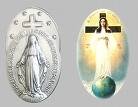
When the children first saw here she stood with her hands extended "like the miraculous medal." What impressed the children most was her delightful smile, which seemed to be directed at each one of them individually. As news of the strange doings spread quickly throughout the little village, the Curé, the Sisters, and all the inhabitants gathered on the spot. After they had recited the rosary at the pastor's direction, a large white banner slowly unfolded under the figure of the Lady and on it were written in letters of gold the words:

"But pray, my children. God will soon answer your prayer. My Son is willing to hear you."
The need for prayer was all around them and through the children's innocence to see Mary; the hopelessness gave way to prayer for hope. Hope that God would hear their prayers.

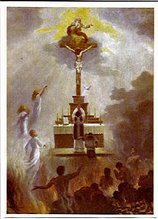
Then one of the Sisters led the group in the singing of the hymn, "Mother of Hope". Our Lady's reaction was immediate. Her smile broadened until the children cried out, "She is laughing!" and she raised her hands to beat time to the music. When the hymn ended, however, her expression became grave for the first time and in her hands there appeared a large crucifix. The cross itself was blood red, the corpus a darker shade. At the top was an extra crosspiece, of white, on which was printed in red letters the inscription, "Jesus Christ." During this part of the apparition, Our Lady's eyes sadly contemplated the cross, the symbol and the pledge of our salvation. With the singing of the hymn, "Ave Maris Stella," the cross disappeared, and Our Lady smiled again, though this time not without a touch of sadness. This tender expression remained on her face until, after the recitation of night prayers by the crowd, a white cloud veiled the Lady from view and the apparition was at an end. Before the news of the event at Pontmain had spread beyond the neighbourhood, Our Lady's promise came true. The very day after the apparition, the Prussians halted their advance and withdrew ten mils. Peace came to the devout clients of Mary in Western France.

The Bishop of Laval lost no time holding a thorough inquiry into the apparition. Careful questioning of the four children and many adult bystanders led him to pronounce that a true apparition of the Blessed Virgin had taken place at Pontmain and to authorize her "cultus" at the scene. Many years later Pope Pius XI, after an exhaustive examination of the evidence, confirmed the decisio0n of the Episcopal court and granted a Mass and Office proper to our Lady of Hope of Pontmain. The barn from which the children had first seen the strange vision in the sky was turned into a chapel and soon became a place of pilgrimage. After the death of the elderly pastor, Father Michael Guerin, the Oblates of Mary Immaculate were placed in charge of the shrine. They erected the great basilica of Our Lady of Hope, which was consecrated in 1900.

During the trying days of German occupation in the last war, devotion to Our Lady of Hope received a new impetus. Since the end of the war, tens of thousands of pilgrims have journeyed to Pontmain to pay their thanks to the Mother of Hope or to seek her further intercession. The Oblate Fathers and Brothers introduced the devotion to America in 1952.

Friday, November 30, 2007

Our Lady of Hope - Part II


The Apparition at Pontmain

January 1871 was one of the darkest times in the history of France. The Empire had fallen before the advance of the Prussian armies, Paris was under siege, and the enemy forces were driving West. On January 17, the Prussian armies were at the outskirts of Laval. That afternoon the Bishop of Saint-Brieuc signed a solemn vow to Our Lady of Hope, which was read, in the cathedral at six o'clock. Mary chose this particular time to show, in a most extraordinary way, that the prayers of the French people would be answered.

It happened on January 17th, 1871. The German army neared the west of France. The mass of its deserters was endless. They would not heed the commands of their officers, and even though two were executed, it did not stop others from running away.

The snowy weather made for miserable discomfort. All day and night wagons passed through Laval from east to west. All bearing wounded whom needed care.

The countryside farmers feared the onslaught of needy and hid their possessions of money, food, wine and linens. Typhoid had broken out and Small pox threatened all. Everything seemed doomed.

Just days before, the Aurora Borealis produced fear and awe in many. Some reported the evening lights as tall masts of ships and others claimed them to look like the steeples of a great cathedral.

The worst fear came with an earthquake at about half past twelve the day of January 17th. No one saved hope for anything. Despondency surmounted unbeatable. Shouts of "No use in praying. God doesn't hear us!" prevailed from even the most optimistic

In a barn, a family of two young boys and their father crushed thorns to feed the horses. Eugene Barbedettes, twelve and his brother, Joseph, aged ten, were fascinated with the Northern lights and were anxious to see the show that night.

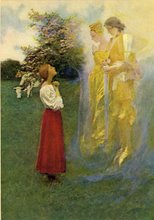
It was in a little village of Pontmain, near the northern end of the diocese of Laval, that the miraculous event occurred. From six to nine that evening the Blessed Virgin appeared continuously in the sky over one of the houses in the village.

The apparition was witnessed by four small children, Eugene and Joseph Barbadette, Francoise Richer, and Jeanne-Marie LeBosse. Joseph, who later became an Oblate of Mary Immaculate, described the Lady as about twenty years of age and very beautiful.

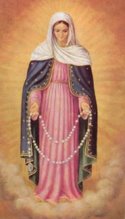
She was dressed in a star-studded robe of dark blue with slippers of the same colour. A black veil on which she wore a gold crown decorated with a red band covered her head. It was in a little village of Pontmain, near the northern end of the diocese of Laval, that the miraculous event occurred. From six to nine that evening the Blessed Virgin appeared continuously in the sky over one of the houses in the village.

Wednesday, November 28, 2007

Our Lady of Hope - Part I


BACKGROUND


In the tenth century, a wave of barbarism had spread across Europe after the break-up of the Empire of Charlemagne. Constant warfare menaced the life of the average Christian. Yet in the year 930, Confidence in Mary, Mother of God, triumphed over pessimism in a little town of Northern France. At Mezieres, the first known shrine was erected in honour of Our Lady of Hope. The next two centuries saw numerous sanctuaries dedicated to Mary under the same or similar titles. In face, throughout the Middle Ages and even down to the 17th Century, the erection of new shrines to Our Lady of Hope proved the widespread popularity of this devotion. Devotion to Our Lady of Hope was gradually eclipsed by the newer and better publicized devotion of modern times.

The revival of devotion to Our Lady of Hope in modern times was due to the zeal of a young Breton priest, Paul-Marie Prud'homme, later Canon of the Cathedral of St. Brieuc. When a seven-year-old child, hopelessly ill of typhoid fever, was cured through her intercession, the young priest threw himself wholeheartedly into the Apostolate of Hope. That was in February 1848, and the revolution, which broke out later in the same month providentially, aided his cause. The chapel of Our Lady of Hope became the centre of a crusade of prayer for France.